


187. LIBELED LADY, 1936
Updated: Jan 28
A jubilant, star-powered screwball classic

This week’s joyous classic, “Libeled Lady”, aligns a constellation of four legendary stars — Jean Harlow, William Powell, Myrna Loy, and Spencer Tracy — to create a jubilant supernova of wit, glamour, and star power. The result? One of the year's biggest box-office hits and one of the sharpest and best comedies of the entire 1930s. Smart, spirited, and gloriously fast-talking, this sublime screwball romp was tailored to the talents of its stars, and as such, offers a splendid window into the Hollywood Studio Era’s star system. A Best Picture Oscar nominee, it crackles with energy and charm, and remains as irresistible as ever.

The film opens as The Evening Star newspaper’s printing presses roll out the morning edition. A phone rings, the presses grind to a halt, and a man shouts “Hold everything for a new front page! We’re killing the ‘Allenbury’ yarn!”. He’s referring to the paper’s headline, which mistakenly branded rich and haughty heiress “Connie Allenbury” a husband stealer. But it’s too late. The first truckload of papers has already hit the streets. Worse still, “Connie’s” father, "James B. Allenbury", has been at war with the paper for twenty years and would love nothing more than to see it fold.

Panic erupts and the staff summon managing editor "Warren Haggerty” to save the day — interrupting him at home as he’s donning a tuxedo, minutes away from marrying his longtime fiancée, “Gladys Benton”. A devoted workaholic, “Warren” ditches his wedding (as he’s previously done to “Gladys”), rushes to the office and learns that “Connie” has slapped The Star with a staggering $5 million libel suit — enough to put it out of business.
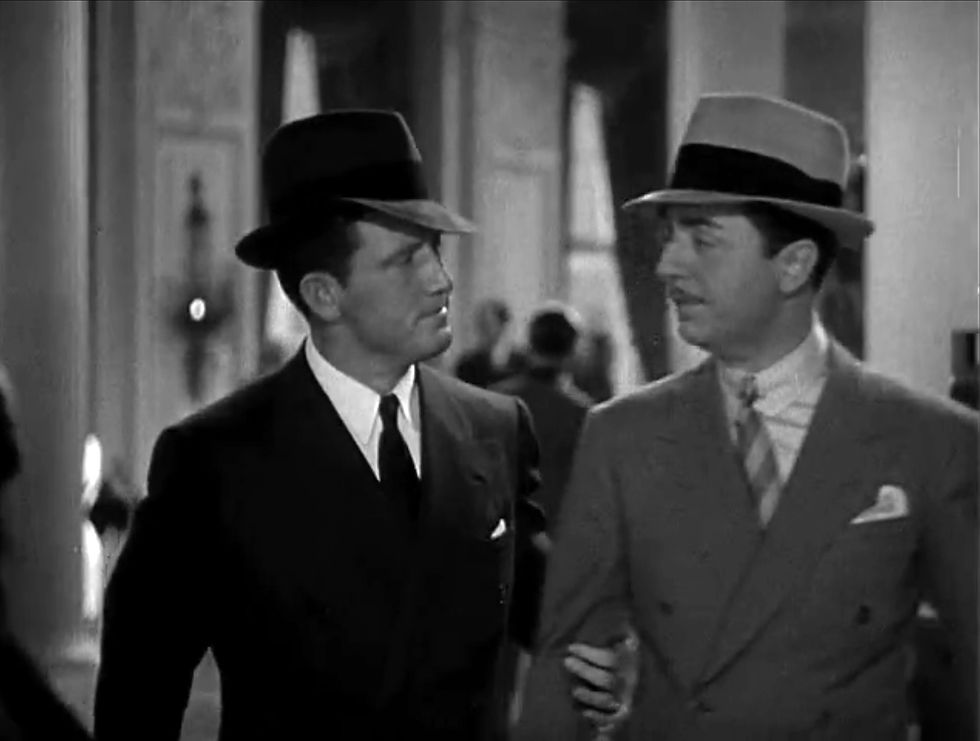
“Warren” knows there’s only one man who can save The Star — “Bill Chandler”, the sharpest libel specialist the paper ever had until “Warren” fired him two years ago. Though still at odds with “Warren”, “Bill" agrees to help. Their solution? Turn the accusation of “Connie” as a husband stealer into reality, igniting a plethora of screwy antics, wild complications, and surprising romances. And so begins “Libeled Lady”!

More than most screwball comedies, “Libeled Lady” magnificently balances emotional realism with zany farce, as we watch characters grapple with pride, deception, honor, jealousy, and love. It's almost like a drama filled with wild shenanigans and jolly zingers. But as outrageous as it gets, it remains believable. That's due in part to the fabulously funny and playfully provocative screenplay by Maurine Dallas Watkins, Howard Emmett Rogers, and George Oppenheimer, and of course, its bevy of amazing actors. It's also a result of the film’s direction by Jack Conway.

Conway masterfully blends breakneck humor and intelligent wit with romantic tension, never letting “Libeled Lady” lose its buoyancy — even in darker emotional moments such as the jilted “Gladys” charging into the newsroom in her wedding gown (bouquet in hand) or “Connie” quietly confessing her poor judgment about men to “Bill” in the moonlight. Conway’s style is brisk and unobtrusive, producing a compelling pace while keeping the focus squarely on action, performances, and comedy.

The first scene with "Gladys" is a prime example. Set in the newsroom, in only three lengthy shots, Conway establishes the paper’s crisis, the bustle of the newsroom, “Warren’s” authority, and his relationship with “Gladys”. The camera glides with the characters, pulls back to add new ones, and pushes in for emphasis, all while including the frantic newsroom energy. The relationship between "Warren" and "Gladys" is neatly framed by her bold entrance at the end of the first shot and her exiting the same way at the end of the last. The way Conway fluidly moves actors and camera positions transforms an abandoned bride, a work-obsessed editor, and a newspaper in peril into engaging intrigue — emblematic of his understated direction, which lets both the comedy and performances shine, even when the emotional stakes are heavy.

There are a handful of exceptions to Conway’s invisible direction, which he uses to great measure, such as the dissolves and music that add excitement when “Warren” is searching worldwide for “Bill”, or the elegant way he shows the passage of time during a dinner scene by showing three trout on a table in a serving platter replaced by a cigarette nearing its end, a cup of coffee, and a napkin being set down. This sort of smooth, sophisticated, visually exciting direction makes this film a nonstop delight.


Jack Conway began as a stage and silent movie actor, which may account for his knack at consistently drawing out great performances from actors in his films. He started directing in 1913 and signed with Metro-Goldwyn-Mayer studios (MGM) in 1925, where he remained an in-house director for the rest of his career, reliably churning out dozens upon dozens of entertaining films. Though never nominated for a Best Director Oscar, three of his movies earned Best Picture nominations: 1934's "Viva Villa!”; 1935's "A Tale of Two Cities”; and "Libeled Lady”. Read more about the life and career of Jack Conway in my post on “Red-Headed Woman”. Click the film's title to open it.

At the heart of “Libeled Lady” are its movie stars — and who doesn’t love movie stars? During Hollywood’s Studio Era they were the primary reason people flocked to theaters. As such, manufacturing stars became an industry of its own inside Hollywood’s biggest studios. By the 1930s, MGM had become Hollywood’s largest and most profitable studio, with the most moneymaking star names under contract than any other studio — proudly proclaiming it had “more stars than there are in the heavens”.

Movie stars of this era weren’t just famous actors, they were gods and goddesses shaped by teams of people including studio executives, screenwriters, publicists, costume designers, hair stylists, make-up artists, directors, cinematographers, and most importantly, the public. As Myrna Loy reflected in her autobiography “Being and Becoming”: “It was hell getting started, but once you were in, they coddled and cared for you. They groomed you and made you look wonderful. They saw that you played lots of different roles, and if the public responded to a particular characterization, the studio would exploit it".

Cashing in on its stable of stars, MGM revisited the “all-star cast" formula with “Libeled Lady” — an approach they virtually created with the runaway success of their 1932 Best Picture Oscar winner, “Grand Hotel”. The trailer for “Libeled Lady” boasted “Not 1, Not 2, Not 3, but 4 Great Stars Gloriously, Uproariously Together!”, and the film delivers — featuring each of the stars completely in their element. That's because "Libeled Lady" was designed as a means to showcase and reinforce the box-office appeal and value of four of MGM's top stars.


Heading the cast is Jean Harlow as “Gladys Benton”, the perpetually scorned bride. Though nearly everyone takes advantage of her, Harlow plays “Gladys” with such feisty strength and innocence that she’s never a victim, just a good-natured, honest gal hopelessly in love and aching to marry. Given much of the film’s sharpest dialogue, Harlow fires off every wisecrack with remarkable precision and candor over a bed of genuine vulnerability. Her formidable talent is evident from her first appearance in the wedding-gown, delivering woeful talk of repeated jiltings with natural and impeccable comic timing, making the pain funny while grabbing our sympathy. Harlow’s matchless blend of emotional sensitivity, simmering sex appeal, and masterful control of every beat make the final hotel-room scene one of the film’s richest and most emotionally rewarding. Sexy, funny, dismaying, and moving, Harlow was a true movie star.


Accounts of Jean Harlow’s life vary, including what drew the well-educated, and well-bred actress to films (boredom, a dare, or the fulfillment of her mother’s unrealized ambitions), but once she entered Hollywood, her rise was swift Born Harlean Harlow Carpenter in Kansas City, Missouri, she adopted her mother’s maiden name — Jean Harlow —and appeared in more than a dozen extra and bit parts before landing her first speaking role, a small part in 1929’s "The Saturday Night Kid" starring Clara Bow (reportedly because she fit into a dress Bow had outgrown). There, Harlow met actor James Hall, who was appearing opposite Ben Lyon in Howard Hughes’s World War I epic "Hell’s Angels". When Hughes converted the film from silent to sound and needed to replace lead actress Greta Nissen because of her heavy Norwegian accent, either Lyon or Hall reportedly recommended Harlow. Playing a woman involved with two brothers, "Hell’s Angels" catapulted 18-year-old Harlow from obscurity to international fame. Hughes signed her to a contract and loaned her to other studios, and she was quickly typecast as various “loose” women. Though untrained and not yet widely respected as an actress, Harlow’s platinum-blonde hair, luminous complexion (which uniquely photographed as real skin), and curvaceous figure made her sound cinema’s first sex symbol.


While working on “Hell’s Angels”, Harlow met MGM producer Paul Bern. The two fell in love and married. Because her overtly sexual screen image clashed with MGM’s preference for elegant, ladylike stars, Bern had to fight to get MGM to consider signing Harlow. But the studio's head of production, Irving Thalberg, envisioned reshaping her into a sexy, wisecracking comedienne. She was signed and MGM tailored 1932’s “Red-Headed Woman” to this new persona, earning Harlow rave reviews and establishing her as a respected actress and star. With her next film, 1932’s “Red Dust“, MGM added a heart of gold to her saucy image, and full-fledged superstardom resulted. A string of hits made her one of Hollywood’s top box-office draws, even after strict enforcement of the Motion Picture Production Code forced her to soften her image. Eager to play more varied roles, Harlow was cast in several dramas like “Riffraff”, the romantic comedy-drama “Wife vs. Secretary”, and “Suzy”. Audiences, however, wanted Harlow's wit and sparkle back, and “Libeled Lady” was designed to deliver just that, and it did, as The New York Times declared in its glowing review: "we are so pathetically grateful to Metro for restoring Miss Harlow to her proper métier”.


“Libeled Lady” was not only a major hit but a personal triumph for Harlow, elevating her to MGM’s top female spot, surpassing Greta Garbo and Norma Shearer. Tragically, her reign was brief. While shooting her next film, “Personal Property”, Harlow grew increasingly exhausted, gained unexplained weight, appeared puffy and bloated, and her translucent complexion turned grayish. While shooting her following film, “Saratoga”, she became progressively weaker and withdrawn, with abdominal pain, sweating, vomiting, and severe swelling, until she had to stop working and go home. Her condition rapidly worsened, and nine days after leaving the set, a suffering Jean Harlow died of kidney failure on June 7, 1937, at 26 years old, about nine months after completing “Libeled Lady”. You can find more about the life and career of Jean Harlow in my previous posts on “Red Dust”, “Red-Headed Woman”, and “Bombshell”.


William Powell is the second star of “Libeled Lady”, playing “Bill Chandler”, a specialist in handling libel lawsuits. Coolly confident and impeccably mannered, Powell makes “Bill” a charming hustler who uses irresistible charisma to mask shrewd calculation. His suave authority is instantly seen with his smooth, fast-talking manipulation of “Warren” in his first scene. Powell’s easygoing naturalness and expressive face, make him endlessly beguiling — whether calmly shaving while memorizing trout-fishing facts, sparring sarcastically with “Connie" as he calls her fragile, or as doubts creep in about deceiving “Connie” on the raft. His agile physical comedy also adds a light touch of slapstick, particularly when fishing. Grace and humor had recently become key elements to Powell’s superstardom, and the role of “Bill” was perfectly designed to highlight each. The following year, Powell became Hollywood's fifth biggest box-office champion.


Born in Pittsburgh and raised in Kansas City, Missouri, William Horatio Powell was expected to become a lawyer. But determined to be a stage actor, he defied his parents, borrowed money from an aunt, and moved to New York City to study at the American Academy of Dramatic Arts. After graduating, he made his Broadway debut in 1912’s “The Ne'er-do-well”, followed by steady stage work, including in a Shakespearean stock company. Lean years followed until he was spotted by director Albert Parker in Broadway's “Spanish Love”, who then cast him as a villain in his 1922 silent film “Sherlock Holmes”. Appearing in two more movies that same year, Powell's silent film career flourished in supporting roles (often as villains), yet after thirty-five films, stardom eluded him. The arrival of sound in 1927 changed everything, highlighting his mellifluous voice, transforming him into a leading man. Fame came playing a heroic, slightly humorous detective in his second talkie, 1929’s “The Canary Murder Case“, though not quite stardom. By the early 1930s, many in Hollywood already considered him old and washed up.


After being under contract at Paramount and Warners, Powell’s fortunes reversed when he signed with MGM in 1934. At the urging of producer David O. Selznick and director W. S. Van Dyke, he was cast opposite Clark Gable and Myrna Loy in 1934’s “Manhattan Melodrama”. A surprise hit, it made Powell a major star. Next came Van Dyke’s suave comedy “The Thin Man” — a blockbuster that earned Powell a Best Actor Oscar nomination and superstardom, establishing his enduring screen persona of sophistication, charm, and debonair wit. MGM capitalized on this image, and Powell became a major box-office draw in a string of hits, including the 1935 musical “Reckless” opposite Harlow. In 1936 alone, he starred in five films, including Best Picture Oscar winner “The Great Ziegfeld”, the screwball comedy “My Man Godfrey" (with a second Best Actor Oscar nomination), the hit “After the Thin Man”, and “Libeled Lady”. Read more about Powell’s life and career in my previous posts on “The Thin Man" and “My Man Godfrey”.


Though “Bill” and “Gladys” spar through much of “Libeled Lady”, there’s a genuine warmth between them, and for good reason. In real life, Powell and Harlow were deeply in love. They met on the MGM lot in 1934 and quickly became inseparable. Harlow, in her mid-20s, was already twice divorced and once widowed, and Powell, in his mid-40s, was twice divorced (most recently from Carole Lombard), and wary of marrying again. Never driven by stardom, Harlow’s true dream was to be a wife and mother. Accounts differ on whether the two planned to marry, were engaged, or neither, and the exact nature of their commitment remains uncertain. Powell did give Harlow a star sapphire ring without proposing (which she affectionately called her “un-engagement” ring). When Harlow fell ill during “Saratoga”, she stopped to see Powell before going home. He stayed in close contact, visited her in the hospital, paid for her funeral, and was devastated by her death, reportedly suffering a physical breakdown at her funeral. He went to Europe to grieve, was diagnosed with (and survived) rectal cancer, and married once more in 1940, remaining so until his death. Being too painful, it's said he never spoke of Harlow again. “Libeled Lady” preserves fleeting but unmistakable traces of their mutual affection.


The third star of “Libeled Lady” is Myrna Loy, as “Connie Allenbury”, one of the richest girls in America. Loy is fantastic at portraying aloof and ultra-rich in a fun and non-brittle way, as we see in her first scenes with a tennis ball, surrounded by the press, or trying to feign interest in “Bill” during their first encounter on the ship. But as “Bill gets to know her, we discover a very human woman who’s overly cautious out of necessity, guarding an unfulfilled yearning for love. Loy displays amazing sarcasm when dancing with “Bill” on the ship, a grounded genuineness when opening up on a raft, and deep concern when talking with her father at the garden party. In her understated style, Loy is modern, strong, and alluring, and can steal focus with a glaring look as easily as a perfectly timed quip. After “Libeled Lady”, Loy quickly became one of Hollywood's busiest and highest-paid actresses, and was dubbed “The Queen” of Hollywood.


Born Myrna Adele Williams in Montana, Loy moved with her mother to Los Angeles in her early teens after her father’s death, set on becoming a dancer. Forced to leave high school to work, she joined a dance troupe that performed live prologues before movies at Hollywood’s prestigious Grauman’s Egyptian Theatre, beginning with Cecil B. DeMille’s 1923 silent epic “The Ten Commandments”. The troupe was occasionally used as film extras, leading to Loy’s first screen work as an uncredited extra in 1925’s “The Wanderer”. Portraits of several dancers were to be displayed in Grauman’s lobby, including the strikingly photogenic Loy. The photographer who took them, Henry Waxman, enlarged several of Loy's photos in his studio, and when silent film superstar Rudolph Valentino visited for a photoshoot, he noticed Loy’s images, asked who she was, then arranged a screen test for his upcoming film “Cobra”. Too young and inexperienced, Loy didn’t get the role, but it sparked her interest in movies. She continued dancing in prologues until boredom set in.


After other dancing engagements and lingering around MGM’s casting office, Loy was asked to do a costume test for the silent film “Ben-Hur” and was considered for the role of the “Virgin Mary”, but ended up playing a slave girl. Soon after, Valentino’s wife asked Loy to play a vamp in 1925’s “What Price Beauty?”, where Loy appeared in a single scene wearing a costume designed by newcomer Adrian. Waxman photographed her in the costume, and the images ran in Motion Picture magazine. Adopting the name Myrna Loy, she soon secured a contract at Warner Bros. where she was largely typecast as vamps, Asians, and other “exotically” ethnic women. Dropped by Warners in 1930, Loy briefly signed with Fox, then freelanced before joining MGM in 1932. At MGM, Thalberg recognized her star potential as a lady rather than a vamp, and gave her better roles, many opposite Clark Gable. Like Powell, her career ignited in 1934’s “Manhattan Melodrama”, and she soared to superstardom later that year as “Nora Charles” in “The Thin Man” opposite Powell. After nearly 80 films, Loy was finally a top movie star.


Few believed Loy could handle comedy, but she proved them wrong in “The Thin Man”, as she recalled in her autobiography: "The Thin Man" finally made me. It put me right up there with the public and the studio. It inspired the press. From that time on, they called me 'the prefect wife', which typed me as confiningly as those vamp roles had. But at least this wife thing, perfect or otherwise, came closer to my own personality". The success of “The Thin Man” also introduced one of cinema’s greatest screen duos, as director George Cukor recalled in Loy’s memoirs: "There had been romantic couples before, but Loy and Powell were something new and original. They actually made martial comedy palatable. I remember Bill Powell when he started out as a melodramatic actor. Then, by some alchemy. he suddenly became comic. But Myrna gave the wit to the whole thing. They hit that wonderful note because he always did a wee bit too much and she underdid it, creating a grace, a charm, a chemistry".


One of the most popular screen teams of all-time, Loy and Powell appeared together in fourteen films (six in “The Thin Man” series), with “Libeled Lady” marking their fifth pairing. Powell later recalled in Loy’s autobiography: “When we did a scene together, we forgot about technique, camera angles, and microphones. We weren’t acting. We were just two people in perfect harmony”. Shaping “Libeled Lady” around its stars' most profitable qualities, MGM smartly ensured that Loy and Powell spent much of the film together, letting their magical chemistry flourish. One scene even shows “Connie” making flapjacks for “Bill” and her father, playfully reinforcing Loy’s “perfect wife” image. Read about the life and career of Myrna Loy in my posts on “The Thin Man” and “The Best Years of Our Lives".


The final star of "Libeled Lady" is Spencer Tracy as “Warren Haggerty", The Star’s managing editor and “Gladys’” long-time fiancé. Introduced as cool and composed (calmly dressing for his wedding as the phone keeps ringing), Tracy soon unleashes Warren’s explosive energy. Always thinking on his feet, he’s constantly talking someone into something (urging "Gladys" to be patient about marriage, persuading "Bill" to help bury the libel suit, or coaxing "Connie" into dropping it altogether), and Tracy delivers this with hilarious mile-a-minute double-talk on top of genuine feeling. We believe Warren truly cares about The Star, and that his anxiety about marriage coexists with real love for "Gladys". Nowhere is Tracy’s immense skill clearer than when he tries to convince "Connie" to drop the lawsuit, deftly shifting through layers of feigned sincerity, mounting desperation, and flashes of devilish glee. Audiences were just beginning to recognize Tracy as a rugged, deeply human everyman, which “Libeled Lady” solidified, propelling him toward top stardom.


Milwaukee-born Spencer Bonaventure Tracy was a tough, smart kid who hated school and had an early love for movies. As Tracy said in Larry Swindell's book "Spencer Tracy: A biography", "I wouldn't have gone to school at all if there'd been any other way of learning to read the subtitles in the silent films". Interested in acting, he won a scholarship to the American Academy of Dramatic Arts in New York City and worked in regional theater before making it to Broadway. Between 1926 and 1930, he appeared in six plays, the last of which was as a murderer in the highly successful "The Last Mile”. Film director John Ford saw that play and ushered Tracy to Hollywood to star as a convict in his 1930 film "Up the River”. It was Tracy’s feature film debut and led to a five-year contract with Fox Film Corporation. Over the course of roughly two dozen films – mostly playing variations of somewhat shady characters – he earned critical acclaim but made little connection with audiences. During this period, Tracy began drinking heavily, which affected his work, making Fox increasingly wary of keeping him under contract.


Eager to bolster MGM’s roster of stars, Thalberg was one of the few at the studio who believed Tracy had star potential, envisioning him as a rugged “man’s man”. MGM signed him and cast him in the lead of 1935’s “The Murder Man”, and then boosted his visibility by pairing him with the studio’s top actresses like Loy in1935’s “Whipsaw” and Harlow in 1936’s “Riffraff”. Then came 1936’s “Fury”, directed by Fritz Lang, a vehicle designed to launch Tracy as a star. Playing a wronged innocent man, his performance struck a chord with audiences, and the film became both a critical and box-office success. “San Francisco” followed that same year, with Tracy starring as a priest alongside Clark Gable and Jeanette MacDonald. A massive hit, it earned Tracy his first Best Actor Oscar nomination, and made him a star. “Libeled Lady” came next, and his equal billing with A-list stars cemented him as one too, and the film helped solidify his tough man with a good heart image. Now a top star, Tracy headlined major productions, often playing noble parts that highlighted his everyman honesty. He won back-to-back Best Actor Oscars for 1937’s “Captains Courageous” and 1938’s “Boys Town”, and was (and is) widely regarded as the greatest movie actor of his era. There's more about Spencer Tracy’s life and career in my post on “Guess Who’s Coming to Dinner”.

For audiences, “Libeled Lady” was simply another hugely entertaining comedy. As you can see, for MGM it was also strategically designed to showcase and strengthen four of its most valuable assets. To further help their films come vividly to life, MGM also employed a deep pool of character actors, many also deliberately typecast so their familiar screen personas would give audiences an instant read on a character, whether villainous, bumbling, or otherwise. I'll highlight just a few.

Walter Connolly is superbly funny as “Connie’s” father, “James B. Allenbury”. Born in Ohio, Connolly appeared in 24 Broadway productions between 1912 and 1935 and in 47 films from 1930 to 1939. No doubt a familiar face (and voice) to classic-film fans, he specialized in gruff, wealthy patriarchs and authority figures, most memorably in screwball comedies. Read more about him in my “It Happened One Night” and “The Good Earth” posts.

Charley Grapewin is quietly affecting as “Hollis Bane", “Warren’s” boss, shading the role with genuine emotion and a quiver in his voice. An outstanding character actor, Grapewin appeared in more than 100 films, often as authority figures and endearing, folksy types in many classics — three on this blog where you'll find more about him: “The Grapes of Wrath”, “The Good Earth", and most famously, as “Uncle Henry” in “The Wizard of Oz”.

Cora Witherspoon is sensational in a brief turn as “Mrs. Burns-Norvell”, an "Allenbury" “friend” and the ultimate society snob. Witherspoon appeared in more than fifty films, often as gloriously snooty women. You can read more about her in my posts on “Dark Victory” and "It Should Happen to You”.

Libby Taylor appears as “Tiny”, “Gladys'” maid, making the most of her one line — “What, again ‘Miss Gladys’?”. Appearing in more than sixty films, Taylor was sadly mostly confined to playing domestics, and you can read more about her in my post on “I’m No Angel”.

If you blink, you’ll miss Hattie McDaniel, seen in the background of the hotel hallway quietly cleaning beneath a window as “Gladys” and “Bill” kiss, An Oscar-winning trailblazer, McDaniel is discussed in my posts on “Gone with the Wind” and “I’m No Angel”.

“Libeled Lady” was remade as the 1946 MGM musical “Easy to Wed”, starring Van Johnson, Esther Williams, Lucille Ball, and Keenan Wynn.

Libel, lies, love, and laughter collide this week in a classic fueled by four Hollywood icons, each bringing their own distinct spark to the fun. Enjoy the utterly enjoyable “Libeled Lady”!
This blog is a (currently triweekly) series exploring classic films from the silent era through the 1970s. Each post recommends a film to watch, aiming to entertain, inform, and deepen your appreciation of cinema — its stars, directors, writers, the studio system, and more. Be sure to visit the HOME page to learn more, subscribe for email updates, and check out THE MOVIES page for a full list of films. Please comment, share with others, and subscribe so you never miss a post. Thanks for reading!
As an Amazon Associate I earn from qualifying purchases, and any and all money will go towards the fees for this blog. Thanks!!
STREAM OR BUY THE FILM AT:
OTHER PLACES TO BUY THE FILM:


Amusing and fantastic movie! 4 outstanding performances by 4 great actors! What a joy! I had a great time watching it! I wish they make more movies likle the classics now a day!! They are light, well played, entertaining, visually beautiful, fantastic writting.... Thank you Jay for another excellent movie! It always makes me sad reading about Jean Harlow, so sad she died so soon... She is so funny and tantelented!
HI Jay, Good movie and what a cast of actors in it. Some of my favorites - Loy and Powell. Thanks again for a great post.
Stuart
Enjoyed this post, Jay -- I especially appreciated learning about Jack Conway (with whom I was completely unfamiliar), the interesting backgrounds of Powell and Loy, and tidbits like the way Harlow reportedly got her part in The Saturday Night Kid! Great stuff.