


188. 12 ANGRY MEN, 1957
An explosive drama of twelve men, one life, and the human conscience
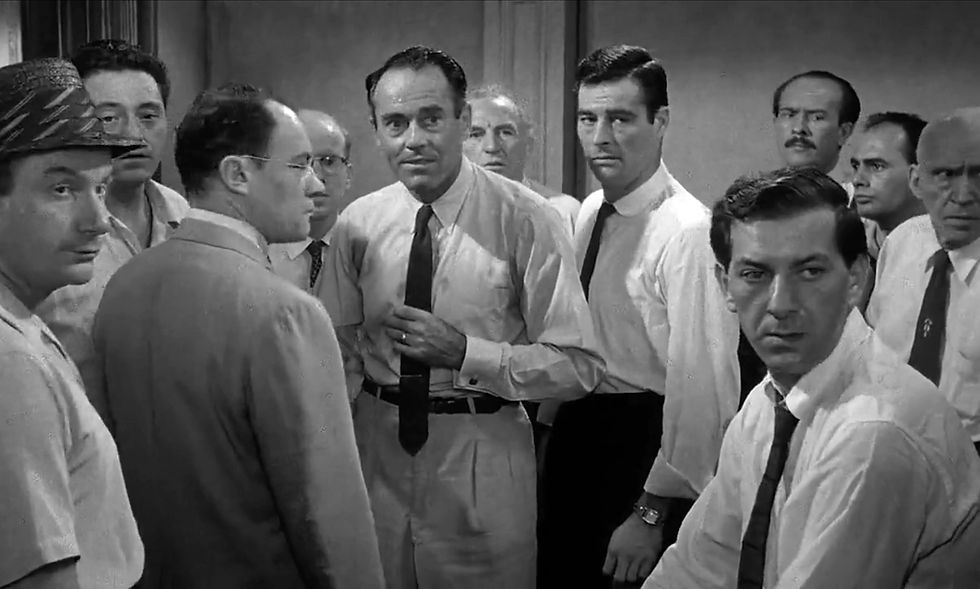
If you think great movies require spectacular scenery, nonlinear storytelling, or big action sequences, think again. For this week’s blistering cinematic masterpiece proves the opposite. A courtroom drama that doesn’t take place in a courtroom, “12 Angry Men” is set almost entirely in a single room unfolding in real time, forgoing spectacle in favor of relentless, start to finish edge-of-your-seat tension.

Widely regarded to be among the greatest films ever made, “12 Angry Men” earned three Academy Award nominations (including Best Picture), was named by the American Film Institute (AFI) the 2nd Greatest Courtroom Drama, 42nd Most Inspiring, and 88th Most Thrilling American Movie of All-Time, and holds a rare 100% rating on Rotten Tomatoes — among countless other honors. Get ready, because once this film begins, its electrifying suspense makes it nearly impossible to look away.

“12 Angry Men” opens as a trial concludes, as a judge instructs a jury that they’ve just heard a complex case of premeditated, first-degree murder and must now separate fact from speculation while applying the law.. Any reasonable doubt they may have requires a verdict of not guilty or they must find the defendant guilty — which in this case carries a mandatory death sentence — and their verdict must be unanimous. He adds, “You’re faced with a great responsibility” before dismissing them, and as the twelve jurors enter the jury room to deliberate, the opening credits roll and “12 Angry Men” truly begins.

Aside from the short prologue above and an even briefer epilogue, the film takes place entirely in the jury room, unraveling in real-time as the twelve jurors deliberate the guilt or possible innocence of an eighteen-year-old boy from the slums accused of killing his father. It’s the hottest day of the year, and what starts off in the sweltering jury oom as an 11-1 vote for guilty, quickly becomes an incisive examination of the best and worst of human nature, democracy, the American jury system, prejudice, the importance of being able to step into another person’s shoes, and the difference between certainty and reasonable doubt.

Through penetrating dialogue, heated emotions, and unforeseen — sometimes shocking twists, the jurors confront their own morals, biases, and values (forcing us do the same) as a man’s life hangs in the balance. It’s a brilliant device for holding a mirror up to humanity and creating high stakes, no-holds-barred drama.
“12 Angry Men” began as a 1954 teleplay by Reginald Rose, inspired by the heated deliberations he experienced while serving as a juror on a manslaughter case. It won three Emmy Awards, including one for Rose's writing. Around this time, United Artists was making deals with a few movie stars (like Burt Lancaster and Kirk Douglas) to finance and release films they starred in and produced. Thinking it might be a perfect fit for movie star Henry Fonda’s honest everyman appeal, United Artists approached Fonda with the idea of turning “12 Angry Men” into a film.

Fonda screened the teleplay, loved it, and then met with Rose, who was happy to adapt his teleplay for the movies, reinstating twenty minutes that had been cut from the TV version. The stunning result earned Rose a Best Adapted Screenplay Academy Award nomination. Fonda and Rose acted as the film’s producers, and as such, each earned Best Picture Oscar nominations.

Made on a modest budget, “12 Angry Men” couldn’t afford an established director, so Rose suggested television director Sidney Lumet, with whom he had previously worked, and Fonda, already impressed by Lumet’s theater work, agreed. The result was Lumet’s remarkable feature film directorial debut.

Directing a film that confines twelve men to a single claustrophobic room might sound like a recipe for boredom, but Lumet met the challenge head-on. Through precise shot choices and a carefully choreographed relationship between actors and camera (at times even allowing characters to speak directly to us), he turns the camera into an active, emotional participant in the drama.

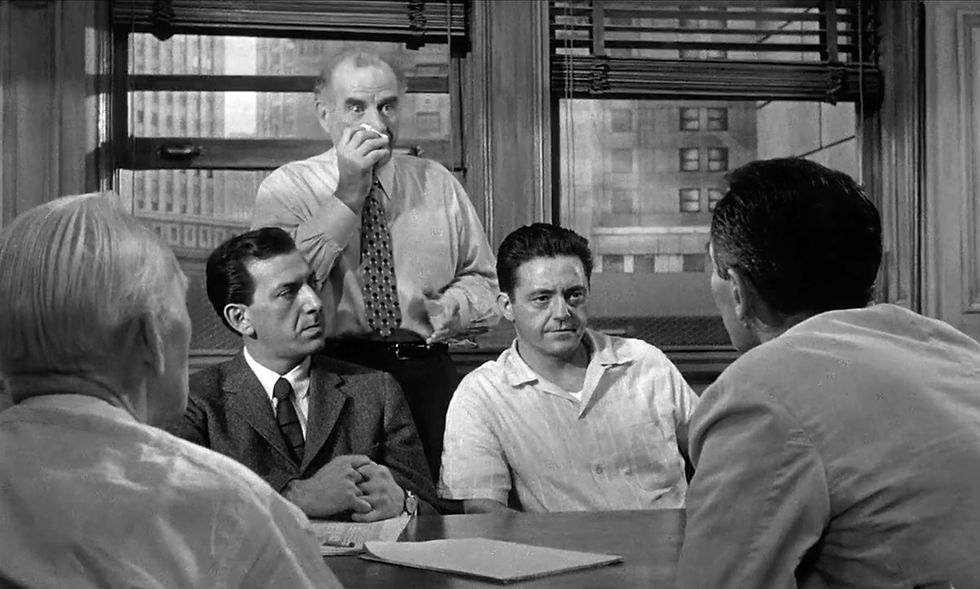
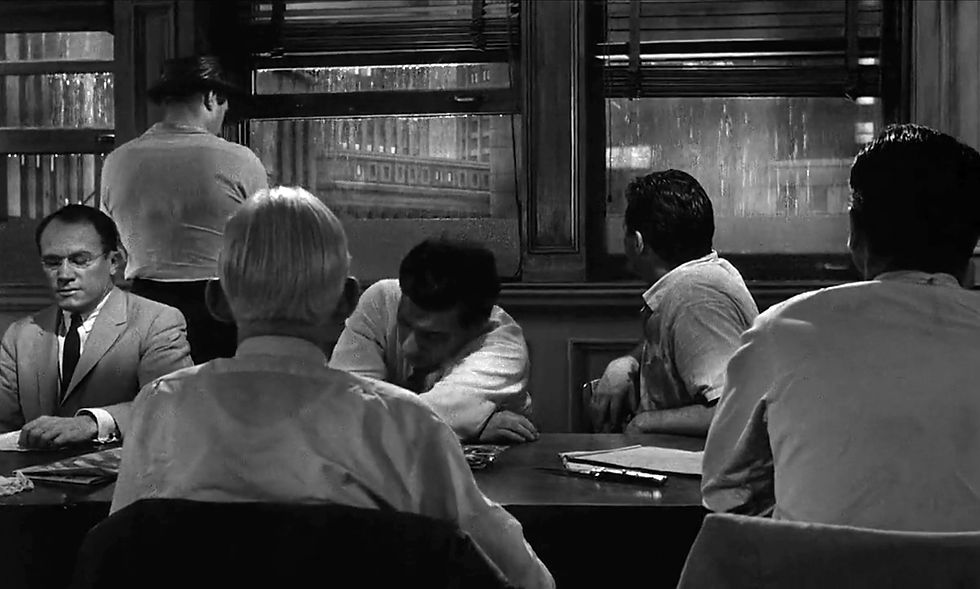
Take the striking first shot inside the jury room. As the shot opens, the camera looks down from above at the empty room, with a wall fan hanging in the foreground marking the fourth wall of this confining space. The shot runs for over six and a half minutes — though it hardly feels that long — as the camera glides left and right, up and down, isolating small clusters of jurors and revealing their personalities as they move through the hot, cramped space. This extended shot allows the men to settle naturally, giving the moment an uncanny authenticity as the camera simply observes them. It ends when the foreman calls, “We’d like to get started. Gentleman at the window, we’d like to get started”, before cutting to a lone figure at the window, "Juror 8”, quietly foreshadowing that he alone has reasonable doubt about the accused’s guilt.

Lumet primarily uses long and medium shots, with medium close-ups to emphasize key moments or reactions, and tight close-ups for when tension boils over. As the film progresses, the men are framed closer together and the camera inches nearer, intensifying the emotion and reinforcing a sense of being trapped — by the room, their inner demons, by each other, and their inability to agree on a verdict. Near the end, as tempers erupt, there are even tighter shots and faster edits, causing the drama to surge with energy.

The result is electrifying cinema and a masterclass in creating exciting drama purely through camera placement, movement, and editing. It earned Lumet a Best Director Academy Award nomination and began the movie career of one of Hollywood’s great film directors.


Born in Philadelphia and raised in New York City, Sidney Lumet was the son of two Polish immigrant performers — a dancer mother and a father who acted, directed, wrote, and produced in the Yiddish theater. Lumet began acting on radio at age four, appeared in Yiddish theater at five, and by eleven, was on Broadway. Over the next seven years, he performed in more than a dozen theater productions where he absorbed invaluable lessons from artists he worked alongside (Max Reinhardt, Joseph Losey, Kurt Weill, Molly Picon, Karl Malden, and others), shaping a lifelong respect for craft, discipline, and actors. He also appeared in several films around this time, including 1936’s “Papirossen” and 1941’s “Journey to Jerusalem”. After serving in the army during World War II as a radar repairman, he returned to find it uncomfortable exposing himself emotionally to audiences. He joined the Group Theatre, and after being thrown out, formed his own workshop where, out of necessity, he began directing. He also served as senior drama coach at New York City’s High School of Performing Arts.

With television’s rise in the early 1950s, CBS recruited theater talent to produce live dramas. Lumet's friend, actor-director Yul Brynner, was working as a TV director and hired Lumet as his assistant director. In 1952, when Brynner left to star on Broadway in "The King and I”, Lumet took over Brynner's role as director. Over the next six years, Lumet directed hundreds of live TV dramas, earned an Emmy nomination, and became a leading director during TV’s Golden Age. The relentless pace of juggling several shows at once taught him efficiency, precision, and the expressive power of camera placement and lenses.

“12 Angry Men” made Lumet’s gift behind a movie camera clear, and from the early 1960s onward, he focused primarily on films. Alongside other directors who moved from TV to movies (like John Frankenheimer and Martin Ritt), Lumet helped shape a new American film sensibility — one that emphasized character, heightened realism, and dynamic camera movement — ushering in a new generation of filmmakers and a cinematic style that would soon be known as the American New Wave.
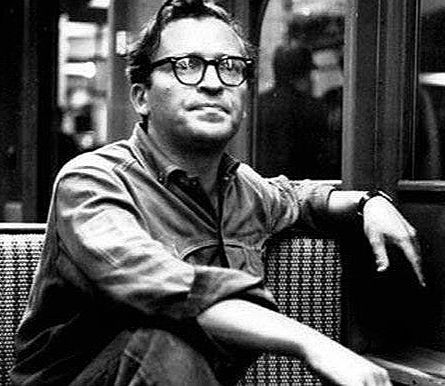
Often called an “actor’s director”, Lumet directed seventeen performances to Oscar nominations and four to Oscar wins. The forty plus films he directed include “Network”, “Dog Day Afternoon”, “Serpico”, “The Verdict”, “Fail Safe”, “Murder on the Orient Express”, “The Pawnbroker”, “The Hill”, “The Wiz”, and his final, 2007’s “Before the Devil Knows You’re Dead”. Lumet was nominated for four Best Director Academy Awards, one for Best Screenplay (“Prince of the City”), earned multiple BAFTA, DGA, Golden Globe and other nominations and wins, and several Life Achievement Awards, including a 2004 Honorary Oscar recognizing “his brilliant services to screenwriters, performers and the art of the motion picture". He was married four times, including to actress Rita Gam, fashion designer and heiress Gloria Vanderbilt, and Gail Lumet Buckley (the daughter of Lena Horne), and is the grandfather of actor Jake Cannavale. Sidney Lumet died in 2011 at age 86.

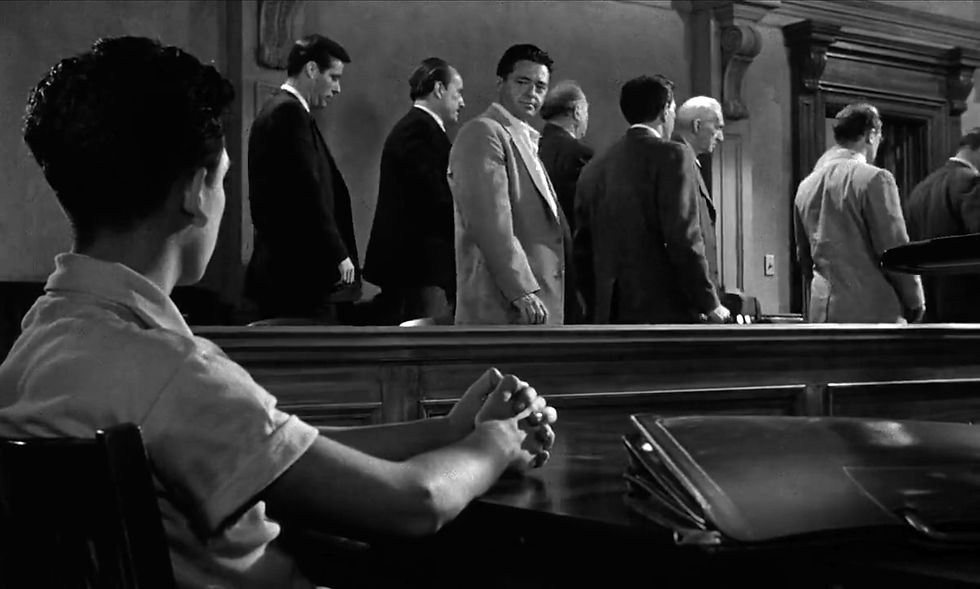
Helping Lumet bring “12 Angry Men” to life is cinematographer Boris Kaufman, whose fluid camera moves and striking compositions keep the film visually arresting. From the inviting tracking shot that glides past the two rows of jurors listening to the judge, to the increasingly tight, unconventional close-ups as tensions rise, his imagery delivers a powerful emotional impact. Though somewhat overlooked today, Kaufman left an indelible mark on the medium.


Born in Poland when it was part of the Russian Empire, Boris Kaufman was the youngest of three brothers, (his siblings were two major figures of 1920s Soviet experimental cinema: documentary filmmaker and theorist Dziga Vertov; and cinematographer Mikhail Kaufman). While his brothers remained in Russia, Kaufman moved to Paris, where he began working as a cinematographer in 1927 on documentaries and collaborating with director Jean Vigo on seminal works of French Poetic Realism such as “Zero for Conduct” (1933) and “L’Atalante” (1934), already showcasing his mastery of close-ups, avant-garde framing, and lighting confined spaces. After serving in the French Army during World War II, Kaufman emigrated to Canada then relocated to New York City in 1942, where his documentary work caught the attention of Elia Kazan, who hired him to photograph “On the Waterfront” (Kaufman’s first American studio feature). The film won eight Academy Awards, including one for Kaufman’s trailblazing cinematography, introducing a new visual realism to Hollywood.

Kaufman's distinctive style carried throughout his American career, which included seven collaborations with Lumet (others include “The Fugitive Kind”, “Long Day’s Journey into Night”, and “The Pawnbroker”), and films like “Splendor in the Grass”, “Uptight”, “Baby Doll” (earning a second Oscar nomination), and his final, 1970's “Tell Me That You Love Me, Junie Moon”. Boris Kaufman died in 1980 at the age of 73.


“12 Angry Men” had top-tier creative talent at every level, including a magnificent cast led by Henry Fonda who is outstanding as “Juror 8”. Calm and thoughtful, with quiet but unshakable strength, he stands alone in the jury’s first vote — not because he is certain of the defendant’s innocence, but because he believes a boy’s life deserves careful deliberation rather than a rushed verdict. “Juror 8” is a man of integrity, fairness, and empathy, qualities Fonda embodies through soft-spoken kindness and unwavering moral conviction. He listens openly, weighs opposing views, and argues his position firmly when necessary — all with such natural truthfulness that his reasoning feels undeniable. The result is a remarkably restrained performance that anchors the film’s pursuit of justice. Fonda’s performance won him Best Foreign Actor BAFTA (British) and Jussi (Finland) Awards, and a Best Actor Golden Globe nomination. Of the more than eighty films in his career, “12 Angry Men" was one of only three he regarded with genuine pride, alongside “The Grapes of Wrath” and “The Ox-Bow Incident” — all centered around justice.

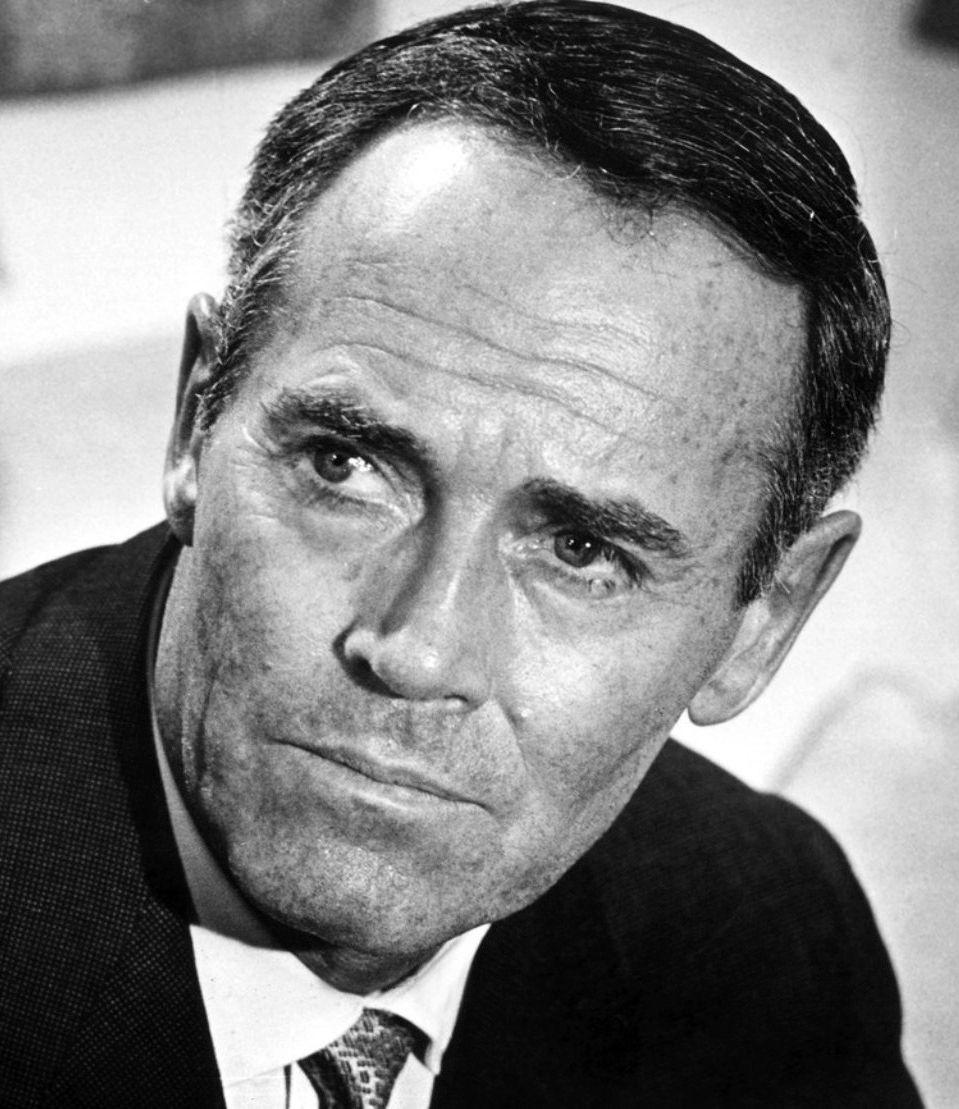
Fonda was the only established movie star in “12 Angry Men”, and his screen persona as an honest, principled everyman willing to stand by his convictions no matter what, made him perfectly suited to the role. It was also the only film he ever produced. Because of its low budget, Fonda accepted deferred pay, and though the film was an award-winning critical success, it was considered more of an arthouse film than a box-office hit. Though not under a studio contract, Fonda was a big enough star to take on films that weren’t expected to make large profits. As he told Mike Steen in “Hollywood Speaks: An Oral History”: “Agents and managers to whom I pay a lot of money for advice will tell me if I want to indulge myself in the theater and film, I have to do a certain number of what are called box-office pictures, or I would be out of the business. You can’t make a career out of a ’12 Angry Men’ or an ‘Ox-Bow Incident’, I understand it, believe it, and agree, because they don’t make enough money. Not that those two films lost money. They were both profitable pictures, but it took a year longer to go to profit, which is not an exciting thing for backers and producers”.

In the long run, “12 Angry Men” cemented Fonda’s image as a symbol of the honest, everyday hero, and AFI later named him the 6th Greatest Male Screen Legend of All Time. Read more about Henry Fonda’s life and career in my previous post on “The Grapes of Wrath”. Just click the film title to open it.

"12 Angry Men” is a true ensemble piece, giving each of its twelve actors a chance to shine. Several went on to stardom and others will be instantly familiar to classic film and TV fans, so I’ll briefly point each of them out.


First off is Lee J. Cobb, who delivers a towering performance as “Juror 3”, the emotionally volatile owner of a messenger service. “Juror 3” is loud, aggressive, and openly contemptuous, yet being a consummate actor, Cobb allows us to feel the vulnerability and despair simmering beneath the volcanic intensity. It surfaces most powerfully when he speaks about his son and in his final, devastating moments in the jury room. For anyone interested in the craft of acting, watch Cobb’s performance. It embodies every hallmark of great acting — he's truthful, reactive, physical, and deeply emotional. Even the way he walks away from the table after his speech about his son is heartbreaking without uttering any lines of dialogue. His remarkable performance earned him a Best Supporting Actor Golden Globe nomination. There's more about Lee J. Cobb in my post on “On the Waterfront”, the film that made him famous three years earlier.

Ed Begley delivers a scorching performance as “Juror 10”, the pushy, abrasive garage owner with a perpetually runny nose. From the start — when the first vote is 11–1 — his snide chuckle and quip, “Boy oh boy, there’s always one”, establish his rudeness. His racism becomes increasingly blatant as he calls the accused a “born liar” solely because of his race. Begley’s offhand, natural delivery makes “Juror 10” feel entirely real, intensifying the impact of his bigotry, and making the scene where he finally erupts genuinely chilling.


Connecticut-born Ed Begley began acting at age nine. He served in the Navy, worked in carnivals and circuses before acting on stage and radio, reaching Broadway in 1943, and making his film debut in 1947’s “Boomerang!”. His prolific career contains more than 100 film and TV performances, a Best Supporting Oscar win for “Sweet Bird of Youth”, two Emmy nominations, and a Tony Award for 1955’s “Inherit the Wind". Notable films include “Patterns”, “Sorry, Wrong Number”, “Hang ’Em High”, “The Unsinkable Molly Brown”, and “Dark City”, and TV appearances include “Guiding Light”, “Bonanza”, “The Dick Van Dyke Show”, and “The Wild Wild West”. He was married three times, and actor Ed Begley Jr. is his son. Ed Begley died in 1970 at the age of 69.
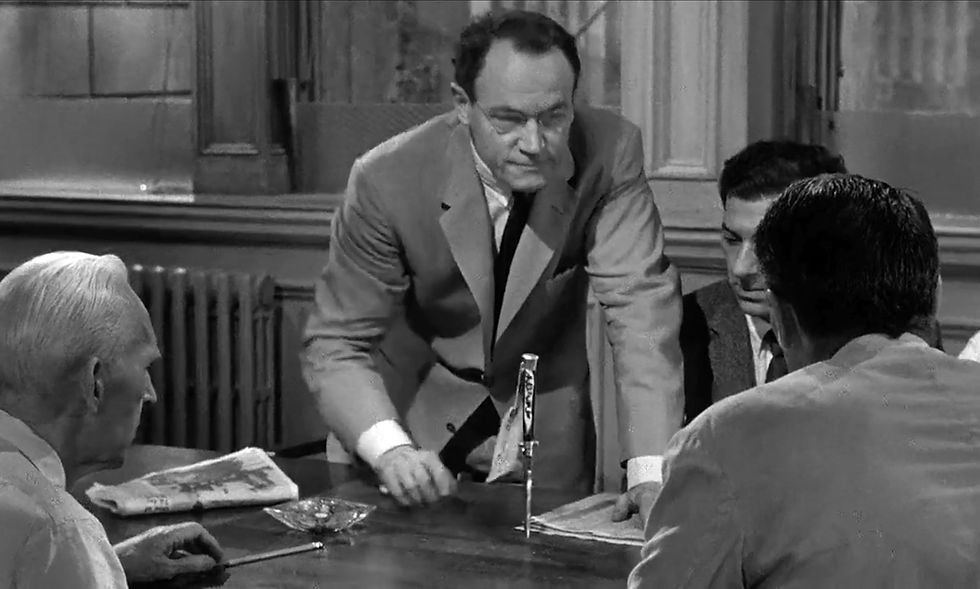
E. G. Marshall is superb as “Juror 4”, the rational, serious stockbroker. He's a man who follows facts, and as new evidence emerges, we see a subtle awakening within in him. Marshall is so convincing in the role, he sparks wonderfully unexpected emotion.


Early records are not clear about Minnesota-born E.G. Marshall, though he made his Broadway debut in 1942's "Jason", his film debut in an uncredited role in 1945's "The House of 92nd Street”, and was a founding member of the Actors Studio. He appeared in original Broadway productions of “The Skin of Our Teeth”, “The Iceman Cometh”, “The Crucible”, and “Plaza Suite”. Over his career, he appeared in 161 films and TV shows including “The Caine Mutiny”, “Compulsion”, “Interiors”, “Superman II”, “Nixon”, and “Absolute Power”, and TV shows like “Alfred Hitchcock Presents”, “Route 66", “The Brady Bunch”, and starring in the 1960's series “The Defenders”, which earned him two Emmy Awards. He was married three times. E.G. Marshall died in 1998 at the age of 84.

Jack Warden gives a bravura performance as “Juror 7”, the wisecracking salesman eager to finish to get to a ballgame. Warden brings depth to this sarcastic, jumpy character, transcending any kind of stereotype, offering a penetrating look of the cost and emptiness of selfishness.


New Jersey-born Jack Warden worked as a professional boxer, bouncer, lifeguard, and other jobs before serving as a paratrooper in WWII. While recovering from a shattered leg, he discovered acting. After his service, he performed onstage in Texas for five years, debuted on TV in 1948, in movies in a bit part in 1950's "Sunset Boulevard”, made his Broadway debut in 1952’s “Golden Boy”, and began his rise to fame with the TV series "Mr. Peepers" in 1952. After nearly 40 TV and film appearances, “12 Angry Men” was his breakthrough. Warden appeared in 167 film and TV projects, becoming a household name by the 1970s, earning two Oscar nominations (“Shampoo”, “Heaven Can Wait”) and an Emmy Award for 1971’s “Brian’s Song“. His other films include “All the President’s Men”, “Being There”, "And Justice for All”, “Mighty Aphrodite”, “The Verdict”, and his final, “The Replacements” in 2000. His TV work includes starring roles in the series "Crazy Like a Fox", "The Bad News Bears”, and "The Wackiest Ship in the Army”. He was married once for over fifty years, until his death. Jack Warden died in 2006 at the age of 85. Read a bit more about Jack Warden in my post on “From Here to Eternity”.

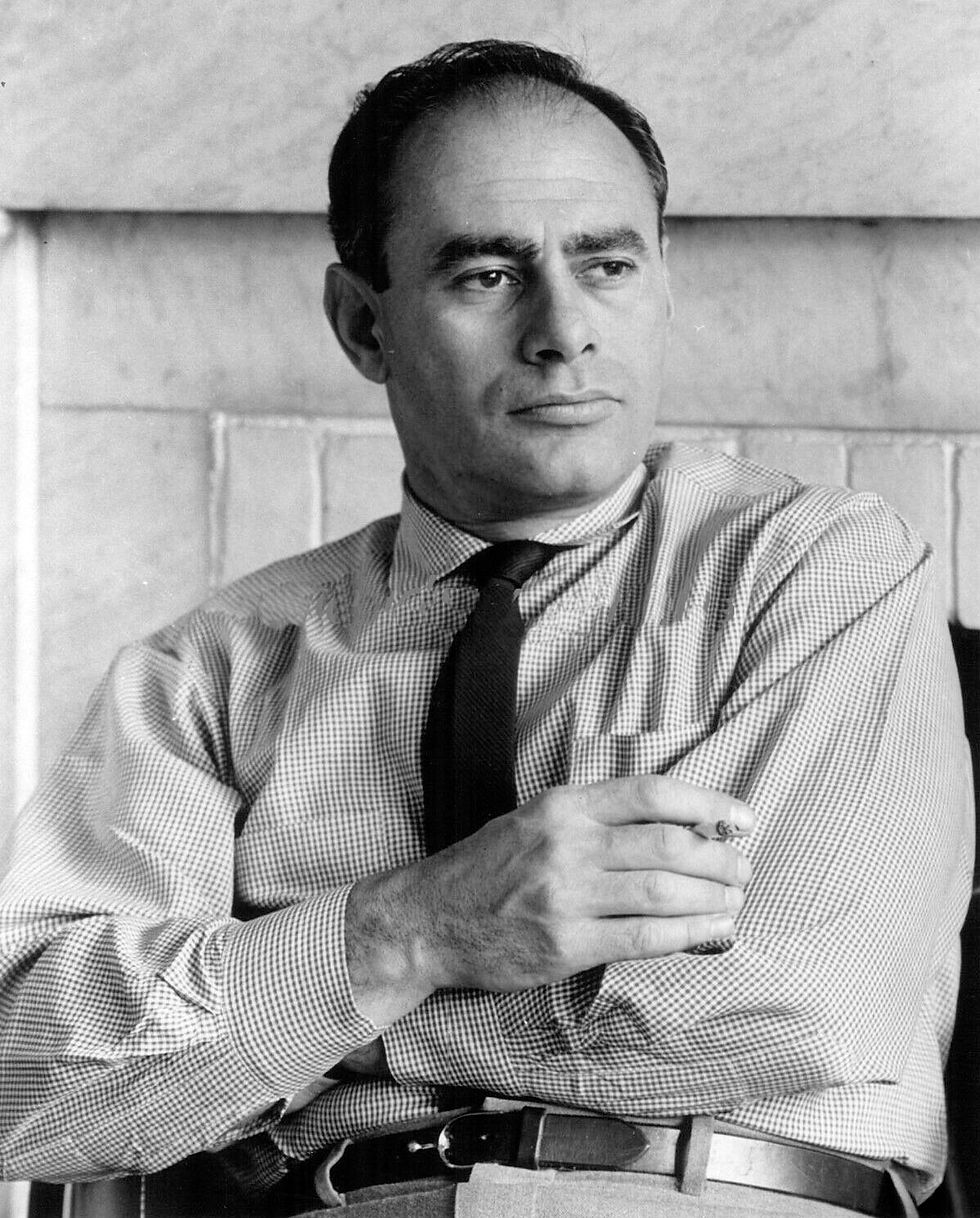
Martin Balsam plays “Juror 1”, an assistant high school football coach and the jury's foreman who does his best to keep the deliberations orderly and moving forward. Balsam perfectly captures this man’s unease at being foreman, along with his sensitivity, notably in his exquisitely delivered short monologue by the window. “12 Angry Men” was a breakthrough for Balsam, marking his first important screen performance (and second film), jumpstarting his movie career. He went on to appear in 179 films and TV shows, became a famous character actor, and an Oscar and Tony Award winner. Read more about Martin Balsam in my posts on "Psycho", "Breakfast at Tiffany's", and "On the Waterfront".

John Fiedler portrays “Juror 2”, the mild-mannered bank clerk. Seemingly meek, Fiedler makes the character quietly conscientious and genuine, providing a distinct counterpoint to the more boisterous ensemble.

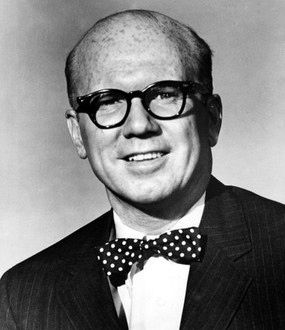
Wisconsin-born John Fiedler staged plays in his garage as a child, and after serving in the Navy, studied at New York City's Neighborhood Playhouse. He debuted on Broadway in 1954, on TV in 1955, and “12 Angry Men” was his film debut. His career changed dramatically when Walt Disney heard the warm, high-pitched kindness in Fiedler's voice and cast him as “Piglet” in 1968’s “Winnie the Pooh and the Blustery Day”. After that, he became the voice of “Piglet” in dozens of films, TV series, shorts, and specials. Over more than fifty years, Fiedler appeared in over 200 film and TV shows. His "non-Piglet” movies include "That Touch of Mink”, “The Odd Couple”, “True Grit”, the animated features “The Fox and the Hound”, “The Rescuers”, and “The Emperor’s New Groove”, and TV shows such as “The Bob Newhart Show”, “The Odd Couple”, “The Golden Girls”, “Bewitched”, “Cheers”, “Get Smart”, “Star Trek”, “The Munsters”, “The Twilight Zone”, and many, many more. He never married. John Fiedler died in 2005 at the age of 80.

Jack Klugman is superb as “Juror 5”, the quiet Baltimore Orioles fan who seems to feel he doesn’t quite fit in. Initially reluctant to speak, when does he carries an intense honesty and vulnerability, making this character simple and moving at the same time. It was Klugman’s fourth film.


Philadelphia-born Jack Klugman began in theater after serving in the U.S. Army during World War II, and made his television debut in 1950 — the medium where he would shine most. That same year, he appeared in his first film and made his Broadway debut in the original production of “Golden Boy”. “12 Angry Men” came after small film roles (including a bit part in “Marty”), and over twenty-five TV appearances. Klugman went on to earn a Tony nomination for the original Broadway musical production of “Gypsy” opposite Ethel Merman, and won his first Emmy Award for a 1964 episode of “The Defenders”. In 1965, he replaced Walter Matthau on Broadway in “The Odd Couple”, and later reprised the role opposite Tony Randall in the hit TV adaptation, which became one of the most popular and acclaimed shows of the 1970s, making Klugman a household name, TV icon, and earning him five Emmy nominations with three wins. He then starred in “Quincy, M.E.”, garnering four more Emmy nominations. Over a sixty-year career, Klugman appeared in 109 films and TV shows, including “Days of Wine and Roses”, “I Could Go on Singing”, “The Detective”, “Goodbye, Columbus”, and TV shows like “The Twilight Zone”, "You Again?”, and “Crossing Jordan”. Married twice, first to actress Brett Somers, Jack Klugman died in 2012 at the age of 90.

Edward Binns gives a fine performance as “Juror 6”, a tough yet sensitive working-class man who takes the case seriously and has no trouble standing up to bullying.


Philadelphia-born Edward Binns had a long career in theater, film, and especially television, often playing no-nonsense detectives, soldiers, and similar types. Over forty years, he appeared in 187 films and TV shows, including “The Verdict”, “Fail Safe”, “North by Northwest” (as military police officer "Captain Junket"), “Night Moves”, “Patton", “Compulsion", and “Judgment at Nuremberg”, and TV series like “Gunsmoke", “Perry Mason”, “The Untouchables”, “The Defenders”, “Hawaii Five-O”, “MASH", and “The Equalizer”. Married three times, including to actress Elizabeth Franz, Edward Binns died in 1990 at 74.

Joseph Sweeney is “Juror 9”, the wise and humane eldest juror who calmly observes everything, offering wisdom when needed. He delivers a very poignant speech about the older male witness. Sweeney was one of only two actors to reprise his role in “12 Angry Men” from the teleplay.


Philadelphia-born Joseph Sweeney had a forty-plus year career, appearing in over thirty Broadway shows (including original productions of “Arsenic and Old Lace”, “The Crucible”, and “The Farmer Takes a Wife” opposite Fonda), nine films (including “The Man in the Gray Flannel Suit”, “The Fastest Gun Alive”, and as the butler in “The Philadelphia Story”), as well as roughly 45 TV shows (including “The Defenders”, “Ben Casey", “Route 66”, and “Father Knows Best”). Joseph Sweeney died in 1963 at the age of 79.

George Voskovec is wonderful as “Juror 11”, an immigrant watchmaker and naturalized citizen who deeply appreciates the freedoms and ideals of democracy. Like Sweeney, Voskovec reprised his teleplay role for the film, giving a touchingly personal and very moving performance.


Born in Sázava, Bohemia (Czechoslovakia), George Voskovec began his career in theater and Czech cinema before immigrating to the United States in 1939. He appeared in about eighteen Broadway productions, including “Hamlet” opposite Richard Burton and the original Broadway production of the musical “Cabaret”. Between 1925 and 1982, Voskovec appeared in 89 films and TV shows including “The Iceman Cometh”, “The Spy Who Came in from the Cold”, “Butterfield 8”, his final, “Barbarosa”, and TV shows like “Dr. Kildare”, “The Untouchables”, “The Defenders”, “Mission: Impossible", and a starring role in “Nero Wolfe”. Married three times, George Voskovec died in 1981 at 76.

Last but not least is Robert Webber, who is excellent as “Juror 12”, a Madison Avenue advertising man. Webber conveys the character’s distracted, somewhat shallow nature without turning him into a caricature, keeping him genuine — especially in the tense moment when he struggles over whether to change his vote.

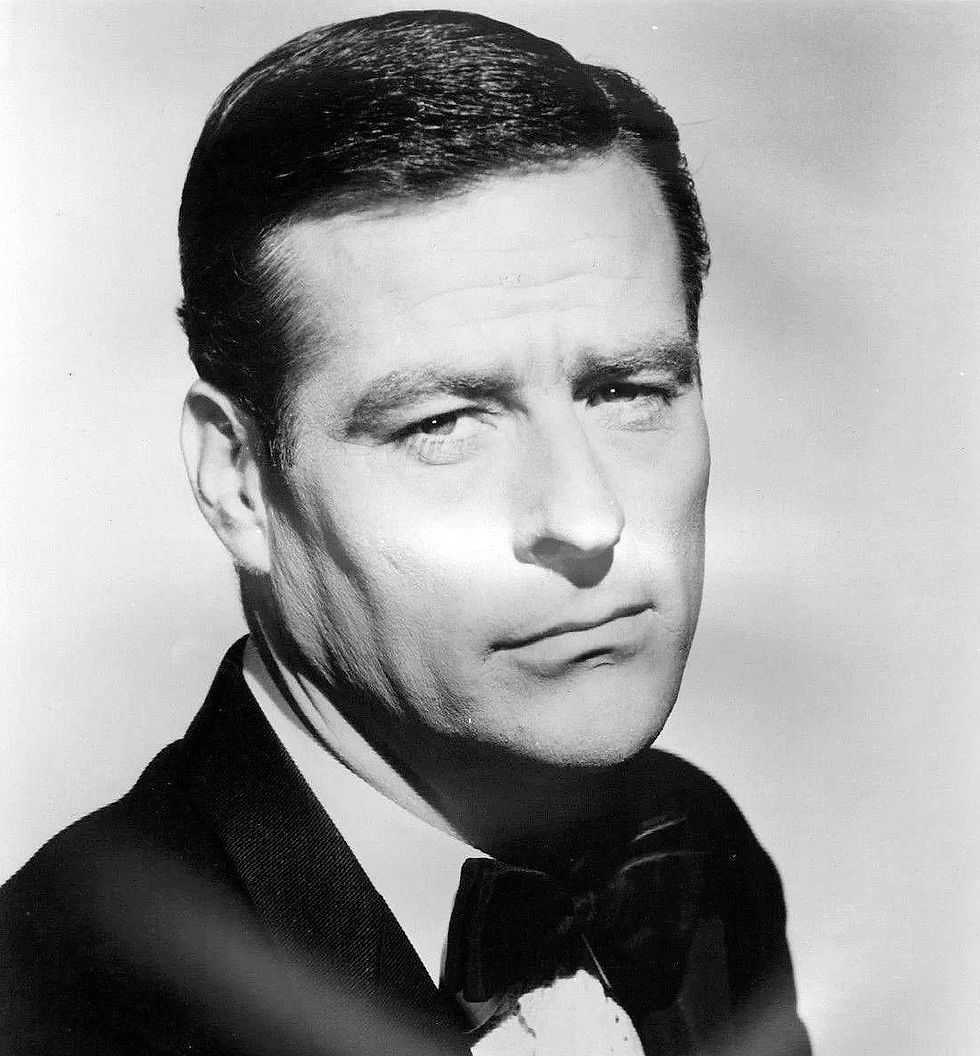
California-born Robert Webber began on Broadway in 1946 and debuted on television in 1950. He continued on Broadway through 1961 and amassed 157 film and TV credits through 1989, including “The Dirty Dozen”, “The Great White Hope”, “Midway”, “Revenge of the Pink Panther”, “Private Benjamin”, “S.O.B.”, “10”, “Harper”, and "Nuts". His TV appearances include “Moonlighting”, “Alfred Hitchcock Presents”, "The Outer Limits”, “The Fugitive”, “I Spy”, “Mission: Impossible”, and “Ironside”. Married twice, Robert Webber died in 1989 at the age of 64.
“12 Angry Men” won the Best Film Writers Guild of America Award and was embraced with enthusiasm by international critics, earning top awards from the British Film Academy, the Italian and Polish Film Critics Associations, and the Berlin Film Festival. The film was remade in the US by William Friedkin in 1997, and other adaptations have been made in countries such as Germany, Spain, Japan, China, South Korea, and Russia. Two stage versions were made, one adapted by Rose, and another by Sherman L. Sergel.

This week’s film showcases cinema at its most focused, fearless, and unforgettable. So enjoy the outstanding “12 Angry Men”!
This blog is a series exploring classic films from the silent era through the 1970s. Each post recommends a film to watch, aiming to entertain, inform, and deepen your appreciation of cinema — its stars, directors, writers, the studio system, and more. Be sure to visit the HOME page to learn more, and check out THE MOVIES page for a full list of films. Please comment, share with others, and subscribe so you never miss a post. Thanks for reading!
YOU CAN STREAM OR BUY THE FILM ON AMAZON
OTHER PLACES YOU CAN BUY THE FILM:
As an Amazon Associate I earn from qualifying purchases, and any and all money will go towards the fees for this blog. Thanks!!


If anyone tells me 12 Angry Men is the best movie ever, I can't argue with them.