


189. SPLENDOR IN THE GRASS, 1961
A searing exploration of sexual awakening and repression, and their emotional cost

Some films cut so deeply into human and emotional truths that they remain ageless, and “Splendor in the Grass” is one. Its hidden depths struck me powerfully when I first saw it decades ago and continue to resonate with every viewing. Astute direction, gorgeous production design, a poignantly explosive script, and electrifying performances made this film a box-office sensation, an Oscar winner, and one of the New York Time’s 10 Best Films of the Year, and decades later, the American Film Institute (AFI) named it the 47th Greatest Love Story of All-Time. This film creates a world so vividly real you can practically breathe in the heat, longing, and moral suffocation of 1920s small town America.

Set in a small Kansas town in the late 1920s just before the Great Depression, “Splendor in the Grass” opens as a boy and girl passionately kiss in a convertible beside a raging waterfall. They are deeply in love high school sweethearts “Deanie Loomis” (the poor, but prettiest girl in school), and “Bud Stamper” (the handsome, wealthy captain of the football team). As their heated passion intensifies, “Bud” wants to have sex. but “Deanie”, who also wants to, is not ready.

Frustrated, “Bud” drives “Deanie” home, where her overprotective mother, “Frieda", spies on them through a window. Fearful “Deanie’s” gone too far with “Bud”, “Frieda” strongly warns her: “Boys don’t respect a girl they can go all the way with. Boys want a nice girl for a wife”. “Deanie” asks her mother if it’s terrible to have “those feelings” about a boy, to which “Frieda” replies: “No nice girl does”.

Once home, “Bud” faces his own directives from his father, “Ace”, a powerful oil man, who cautions him against doing anything shameful with “Deanie”. “Ace” spent his life trying to forge a successful future for “Bud” in the world, and warns him that pregnancy would mean marriage — something “Ace” is determined to postpone until after “Bud” attends Yale University. He warns “Bud”: “There ain’t nothing in this world that I wouldn’t do for you boy. There’s nothing I wouldn’t do if you do right — if you do right. Now don’t disappoint me, son”. But “Bud” only wants to go to agricultural school, become a rancher, and marry “Deanie”.

Trapped by their parents’ demands and society’s strict provincial mores, we watch these two teenagers struggle with the pain of sexual desire, frustration, and repression. The story's hard-hitting power builds out of intensely intimate moments that feel utterly real — such as the erotic joy of a kiss or the explosion of raw emotions during a conversation in a bathtub. It’s a reminder that even the smallest events can shape or shatter a life.

What evolves is a startling portrait of longing and denial, the crushing weight of social expectations, the double standard about sex for men and women, the loss of youth and innocence, and the fragile question of whether romantic love or self-realization can survive in a world ruled by rigid morality, economic ambition, and fear. It’s also intensely enthralling and moving entertainment.

“Splendor in the Grass” was one of the last films in a period when Hollywood made movies centered around the angst of teenagers (such as “Rebel Without a Cause”, “East of Eden”, “The Wild One”, and “Blackboard Jungle”), and its frank, and at times, harrowing look at the effects of sexual repression can be seen as a bridge between what came before and the mainstream sexual revolution and counterculture movement that was beginning to sweep across America.

It all began in the mind of playwright William Inge, who specialized in writing stories that peeked under the rug of small-town America to show humanity with all its warts, earning him the moniker "Playwright of the Midwest”. He first pitched the idea of "Splendor in the Grass" to stage and film director Elia Kazan while Kazan was directing one of Inge's Broadway plays. Kazan thought it would make a great film and agreed to direct it.
Inge developed "Splendor in the Grass" into a novel before adapting it into a screenplay with Kazan’s help. The result captures everyday life with extraordinary emotional depth, layering subtle meaning beneath simple moments, such as “Bud’s” mother's remark at breakfast that “neither of my children gets any real nourishment”. She means food, yet the line resonates far more powerfully as a comment on emotional deprivation. This was Inge’s first original screenplay, and it won him an Oscar.


William Inge’s writing career began with a bang. The Kansas-born writer worked as a laborer and taught English and drama before his friend (and possible lover) Tennessee Williams, urged him to write plays. Inge began with “Farther Off from Heaven” in 1947, followed by “Come Back, Little Sheba”, which reached Broadway in 1950, won two Tony Awards, and became a 1952 Oscar-winning film. It was the first in an extraordinary run of four consecutive Broadway triumphs: “Picnic” in 1952, which earned two Tonys and a Pulitzer Prize for Inge (and two Oscars for its 1955 film version); “Bus Stop”, which received four Tony nominations (and an Oscar nomination for its 1956 film adaptation); and “The Dark at the Top of the Stairs”, directed by Kazan, earning five Tony nominations, including Best Play (and becoming a 1960 Oscar-nominated film). It was during this remarkable streak that Inge conceived and began writing “Splendor in the Grass”.

In addition to writing "Splendor in the Grass", Inge served as associate producer, helped cast the leads, and made a brief on-screen appearance as “Reverend Whitman” (his only film acting role). Although he continued writing plays, novels, and scripts for TV and film, his success waned. Already struggling with alcoholism and the burden of being gay in mid-century America, his career downturn is widely believed to have put him into a deep depression, and in 1973, at age 60, William Inge committed suicide via carbon monoxide poisoning.

Adding emotional intensity, psychological realism, and an almost painful intimacy to Inge’s script for “Splendor in the Grass” is Elia Kazan’s direction. By avoiding clichés and grounding every moment in human behavior, Kazan gives the characters and their conflicts a depth that makes the story feel profoundly real.

The first scene between “Deanie” and her mother “Frieda” is a perfect example. As “Deanie” anxiously straightens her hair, trying to mask her overpowering desire for “Bud”, “Frieda” enters and tells her to drink her milk. The mere thought repulses her, and ”Deanie” puts down the glass without drinking — a telling sign of budding adulthood. The scene ends with “Deanie” alone in bed, flinging her teddy bear to the floor before fervently clutching her pillow and then kissing photos of “Bud” goodnight, giving us a raw portrait of her awakening sexuality.

Between those moments, “Frieda” asks “Deanie” whether she’s gone too far with “Bud", a moment Kazan stages outside a closed bathroom door with “Deanie” unseen inside and “Frieda” in close-up outside. That focuses our attention on “Frieda’s” suspicions while visually and emotionally underscoring the distance between mother and daughter. This beautiful, natural way of using direction to emphasize emotion and meaning is emblematic of Kazan's magnificent work.

Kazan told Jeff Young in “Kazan: The Master Director Discusses His Films”, “[‘Splendor in the Grass’] was the easiest picture I ever made because the script was good. It was pure and simple”. Kazan echoed this in his autobiography, “A Life”, writing that the scenes were “the simplest I’d ever done. People came together, spoke, a point was made, an issue decided, quietly and meaningfully. Then they parted and the story went on”. The result is a piercing exploration of characters’ inner lives, rendered with uncommon honesty and emotional force, and it earned Kazan a Directors Guild of America Best Director nomination.


By this point in time, Kazan had proved himself a top director both in theater and films, having directed about a half dozen Broadway shows, winning three Best Director Tony Awards, and over a dozen films, with two Best Director Academy Award wins out of four nominations. ”Splendor in the Grass” was among Kazan’s biggest commercial hits. A controversial figure who produced some of the greatest films and Broadway productions in history, you'll find more about the life and career of Elia Kazan in my previous posts on "A Face in the Crowd", "On the Waterfront”, "A Streetcar Named Desire", and "Gentleman's Agreement". Click on the titles to open the posts.


As one of the three original founders of the famed Actors Studio, Kazan had a colossal understanding of actors and how to guide them toward tremendous performances. As a result, everyone in “Splendor in the Grass” is remarkable, especially Natalie Wood as “Wilma Dean ‘Deanie’ Loomis”, a girl whose sexuality is ignited by her deep love for “Bud”. Wood is raw and fearless in revealing “Deanie’s” newfound desire, mental anguish, and youthful innocence all at once. In a very sensual performance, we feel her erotic longing in the opening kisses with “Bud” and how she tries to relive and contain it when she returns home. Then there’s the devastating classroom scene where she's emotionally distraught over “Bud” while forced to read a poem by William Wordsworth, and her tour de force of unraveling anguish in the bathtub. Wood’s revelatory performance grounds the film as painfully real, and is often cited as her greatest portrayal (and one of cinema’s great performances), garnering her well-deserved Oscar, BAFTA, and Golden Globe Best Actress nominations.


Wood began in films as a child, became a star as a teen, and after nearly three dozen films and less than two dozen TV shows, at 22 years old, was considered a washed-up child star by many. But Inge thought she’d be perfect as “Deanie”, and had to convince Kazan. Kazan met with her, as he recalled, “to find out what human material was there, what her inner life was. I saw that she was a restless ‘chick’ who reminded me of the ‘bad’ girls in high school who looked like ‘good’ girls. I remembered that kind and how they’d have nothing to do with me, only with the big ‘letter men’, like [‘Bud’]. My memory assured me she was perfect for the part. I could see that the crisis in her career was preparing her for a crisis in her personal life. Then she told me she was being psychoanalyzed. That did it”. Wood was cast.


Wood wanted the part, eager to tackle her first meaty adult role and in need of a prestige film to revive her floundering career. Even so, she had reservations, as she told Manoah Bowman in the book “Natalie Wood: Reflections on a Legendary Life”: “I was very freighted of this role because I felt it would require of me to feel certain things that I, Natalie, still had bottled up inside of me. I thought it would be painful, and it was”. But her performance jumpstarted her career, and established her as a respected actress. By the end of the year (in which she also delivered another outstanding performance in “West Side Story”), she was a major movie star and remained one for the rest of her life.


As emotionally raw as Wood’s scenes in “Splendor in the Grass” were, one proved even more terrifying. At dusk, a despondent “Deanie” throws herself into a lake above a rushing waterfall. Accounts of filming this scene differ, but one fact does not — Wood was terrified of doing it. As Kazan recalled, “She had a terror of water, particularly dark water, and of being helpless in it”. One version says a stunt double was hired but ultimately not used (either she couldn’t swim or couldn’t perform the action Kazan wanted). So Kazan asked his assistant, Charlie Maguire, to "get into the water with [Wood], just out of camera range, while she played the scene of struggling to save herself. This didn’t entirely reassure her, but she did the scene and did it well — then clutched Charlie… On dry land she continued to shake with fear, then laughed hysterically, with relief”.

In Manoah Bowman’s book, Wood offered a different memory: “The crew tied a rope around my waist, and two men held my hands for additional security”. She then heard Kazan whisper, “Let go of her hands”. Her fear turned to anger, giving Kazan exactly the emotion he wanted. In “Natalie Wood: A Life”, Gavin Lambert writes that “in spite of her admiration for Kazan she considered him ‘a trickster’, and would always remember that scene by the lake in the fading afternoon light as another encounter with betrayal”. The chilling part is that Wood herself died young, at forty-three, mysteriously drowning in the dark water of the ocean at night. Read more about Natalie Wood's life and career in my earlier posts on “Rebel Without a Cause”, “West Side Story”, and “Miracle on 34th Street”.


“Splendor in the Grass” contains the film debut of Warren Beatty, starring as “Bud Stamper”, the captain of the football team in love with “Deanie”. Handsome, athletic, confident, and wealthy, “Frieda” tells her husband that “Bud” would “be the catch of a lifetime”. Yet Beatty never lets this charismatic golden boy become a two-dimensional figure by revealing “Bud’s” inner turmoil as he grapples with his father’s ambitions, social expectations, overwhelming sexual desire, and the suffocating mix of sexual repression and overtness around him. With nuanced layers, Beatty conveys desperate yearning and mounting frustration as “Bud” tells his father he wants to marry “Deanie”, unleashed anger when rescuing his sister at the New Year’s Eve party, and shy hopefulness when seeking a doctor’s advice. And the cascade of feelings that ripple through him in his final scene deliver an unexpected emotional wallop. Beatty possesses a compelling screen magnetism, radiating strength and vulnerability — the makings of a true star, which he instantly became. The film also earned him a Best Actor Golden Globe nomination and Most Promising Newcomer win.


A high-school football player who chose to follow in his older sister's (Shirley MacLaine) footsteps, Warren Beatty left college to study acting in New York City. He began appearing on television in 1957 and in 1959, made his only Broadway appearance in Inge's “A Loss of Roses". Though the play received poor reviews, Beatty earned a Theatre World Award and Tony nomination. Recognizing Beatty’s striking looks, dedication, and talent, Inge believed he would be perfect as “Bud” and convinced Kazan to cast him. Kazan liked him immediately and was eager to take a chance on this newcomer. Beatty had a real life irresistible sexual allure that translated to the screen. Here's how Kazan described Beatty in “A Life”: “Bright as they come, intrepid, and with that thing all women secretly respect: complete confidence in his sexual powers, confidence so great that he never had to advertise himself, even by hints".


One of the great heartthrobs of the 1960s and 1970s, Beatty gained a notorious reputation for flings with just about every famous actresses of the era — including Wood. The two had a very public two-year relationship beginning in 1962, after Wood divorced her first husband, actor Robert Wagner. Beatty went on to become a major Hollywood force as an actor, director, and producer, helping usher in a New Wave of American filmmaking in the late 1960s. There's more about that, and about Warren Beatty’s life and career, in my post on “Bonnie and Clyde”. Be sure to check it out.

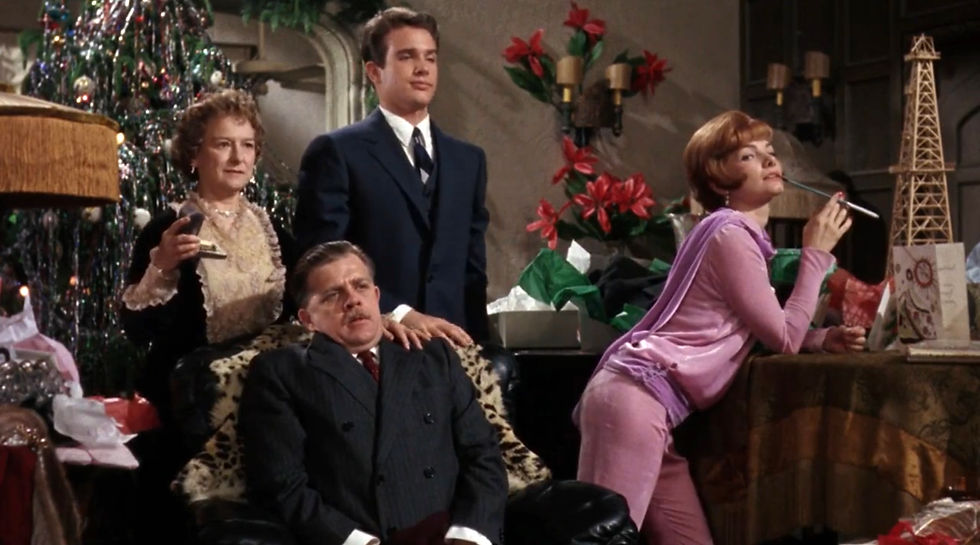
Pat Hingle is phenomenal as “Ace Stamper”, “Bud’s” domineering oil-tycoon father. A force of nature, we first see "Ace" warning “Bud” about sleeping with “Deanie”, not letting him get a word in edgewise. Though loud, overpowering, and volatile, Hingle still conveys the man’s deep love for his son, such as when he listens with tenderness beneath his bravado as “Bud” says all he wants is to marry “Deanie”. He even tries to comfort him by saying, “what you need for the time being, ‘Bud’, is a different kind of girl”. It’s a tough scene, revealing how a parent’s shortcomings can be passed down to their children.

As much as he loves “Bud”, "Ace" shows contempt for his over-sexed daughter “Ginny”, whether in his unbounded fury as he stops her ukulele playing, or when he snaps “you behave yourself” at the New Year’s party. Providing so many windows into this man’s rather heartbreaking inner life, Hingle creates a richly drawn human being. It's acting perfection.


A prolific character actor, Miami-born Pat Hingle began acting in college before moving to New York City to study acting, including at the Actors Studio. He began on TV in 1951, on Broadway in 1953, and made his film debut the following year in a small role in Kazan’s “On the Waterfront”. Hingle continued working across all three mediums, originating the role of “Gooper” in the original Broadway production of “Cat on a Hot Tin Roof”, and earning a Tony nomination for "The Dark at the Top of the Stairs”. In 1958, he appeared on Broadway in “J.B.”, directed by Kazan. During that run, while trying to escape a stalled elevator in his apartment building, Hingle fell more than 50 feet down the shaft, suffering catastrophic injuries, including fractures to his skull, hip, leg, and ribs, and losing the little finger on his left hand — requiring a year of recovery. That accounts for his limp in “Splendor in the Grass” and makes the moment when “Ace” reflects on falling off the crown block of an oil rig, ending his days as an athlete, even more poignant.

In addition to Broadway, Hingle appeared in roughly 200 films and TV shows in over five decades, including “Wild River”, "Norma Rae”, “The Grifters”, three Clint Eastwood films ("Hang ’Em High”, “The Gauntlet”, “Sudden Impact"), as “Commissioner Gordon” in "Batman", "Batman Returns", "Batman Forever", and "Batman & Robin”, and numerous TV appearances on shows like "Dawson's Creeks”, "Murder, She Wrote", "War and Remembrance”, "Gunsmoke", and "The Twilight Zone". He was married twice. Pat Hingle died in 2009 at age 84.

There are few things more mesmerizing than watching an actor fully inhabit a role, and Audrey Christie as “Frieda Loomis”, “Deanie’s” overbearing mother, is proof. The emotional precision she brings is astonishing — the way her expression pivots instantly from breezy small talk to sharp suspicion when she asks “Deanie” about going too far with “Bud”, her giddy joy when their stocks rise, the flicker of feelings she barely suppresses as she puts on a brave face visiting “Deanie” at the hospital, and how her maternal concern collapses into devastation and then panic in the bathtub scene. It’s an extraordinary piece of work.


Chicago-born Audrey Christie studied acting and dancing early on and began performing in vaudeville at 15, soon branching into nightclubs, radio, and theater, reaching Broadway in 1933’s “Shady Lady”, becoming a Broadway mainstay through the 1950s. A consummate character actress, she appeared in just ten films beginning with 1942’s “Keeper of the Flame”, and including “Carousel”, “The Unsinkable Molly Brown”, “Mame”, and her final, “Harper Valley P.T.A.”. TV became her second home, with appearances on dozens of series like "The Waltons", "Charlie's Angels", "Police Woman", "The Fugitive", and "Barney Miller". Her illustrious Broadway career included “The Women” (originating the role later played by Paulette Goddard in the film), “I Married an Angel”, and “The Voice of the Turtle” (which earned her a Donaldson Award), as well as replacement roles in original Broadway productions of “Dark at the Top of the Stairs”, “The Desk Set”, “Come Blow Your Horn", and “Mame”. She married twice, to singer-actor Guy Robertson and actor Donald Briggs. Audrey Christie died in 1989 at age 77.

Barbara Loden plays “Virginia ‘Ginny’ Stamper”, "Bud’s" rebellious, flapper-styled, free-thinking sister. She's worldly, restless, and desperate to escape both her father’s wrath and the town’s provincial hypocrisy. An unloved, lost soul who numbs herself with booze and sex, she dreams of moving to California, telling her family “I hate it here. I’m a freak in this town, everybody stares at me on the street like I was something out of a carnival”, prompting “Ace’s” snide reply: “That’s because you peroxide your hair and paint your face up like an Indian”.

Beneath the anger, laughter, and devil-may-care attitude, Loden reveals deep fragility and raw vulnerability, especially in her tender bond with “Bud” and the harrowing New Year’s Eve party scene. Her free-spirited energy sharply contrasts with the others, exposing another face of repression’s ravaging effects.


Born in North Carolina, Barbara Loden came from a broken home, grew up largely alone, and later described herself as a hillbilly from the backcountry. At sixteen she moved to New York City, became a model, pin-up girl, and dancer before studying acting and joining the Actors Studio. Her first Broadway show was 1957’s “Compulsion”, and she began appearing on television in "The Ernie Kovacs Show" in 1956. While Kazan was preparing his 1957 film, “A Face in the Crowd”, the two met and began an affair. As he wrote in “A Life”: "I'd never encountered anyone like this girl, anyone who'd uncover what is generally kept discreet with such complete candor… Barbara Loden was born antirespectable; she observed none of the conventional middle-class boundaries". He cast her in “Wild River” and “Splendor in the Grass” (while filming, the two carried on their affair in her dressing room).

Loden won Tony and Theatre World Awards for Kazan's original Broadway production of Arthur Miller’s “After the Fall”, and appeared in two more Kazan-directed Broadway shows. She only appeared in three feature films, the third being, “Wanda” in 1970, which she also wrote and directed, and Loden's widely regarded as the first woman to write, direct, and star in a feature film. Though "Wanda" didn’t get much of a theatrical release, it won the International Critics Award at the Venice Film Festival and became a landmark of feminist cinema. Aside from her three films, she appeared in six TV shows and a short film, and continued working in theater until her death. She married Kazan in 1966 (her second and final marriage). Barbara Loden died in 1980 of breast cancer at age 48.


Two actors who have appeared in films already on this blog play smaller roles in “Splendor in the Grass”. The first is Gary Lockwood, who plays “Allen ‘Toots’ Tuttle”, the classmate who takes “Deanie” to the school dance. He makes a memorable impression stopping by her house to ask her out, and again at the dance in an unexpectedly intense scene. This was Lockwood’s fifth film. Seven years later he'd land his best-known role, “Dr. Frank Poole”, in the landmark science-fiction film “2001: A Space Odyssey” directed by Stanley Kubrick. Read more about Gary Lockwood’s life and career in my post on that classic.


The other is Sandy Dennis, who plays “Kay,” one of “Deanie’s" classmates and “Bud’s” date to the dance. Already a replacement on Broadway in “The Dark at the Top of the Stairs” and a performer on the TV soap opera “Guiding Light”, “Splendor in the Grass” marked her screen debut. Though her role is small, flashes of her trademark quirkiness peek through. She would soon win the Best Supporting Actress Academy Award for 1966’s “Who's Afraid of Virginia Woolf?”, and you'll find more about the life and career of Sandy Dennis in my post on that masterpiece.

I must point out comic legend Phyllis Diller, who plays “Texas Guinan", the hostess and comedienne who crack jokes about the Great Depression in the club where “Ace” takes “Bud".


A trailblazing stand-up comedian, actress, author, musician, and artist, Ohio-born Phyllis Diller's wildly eccentric persona, self-deprecating humor, and unmistakable cackling laugh made her one of the most recognizable comics of the 20th century. A pioneer for women in comedy, she was among the first solo stand-ups — male or female — to achieve major national success, helping pave the way for comics like Joan Rivers and Ellen DeGeneres. Breaking through in nightclubs in 1955, she became known for her flamboyant costumes, wild hair, rapid-fire jokes, and routines about her fictional husband “Fang”, reshaping what women could do in stand-up. She became a household name through decades of stand-up, bestselling albums, and nearly 100 film and TV appearances, starting with “Splendor in the Grass”, and including the films “Eight on the Lam” and “The Sunshine Boys”, and TV shows like “Rowan & Martin's Laugh-In”, “The Bold and the Beautiful”, and her own “The Phyllis Diller Show”. She also voiced characters in “A Bug's Life”, “Family Guy”, “The Adventures of Jimmy Neutron: Boy Genius”, and more. Beyond comedy, she was an accomplished pianist, a painter, gourmet cook, and bestselling author. Married and divorced twice, including to actor Warde Donovan, she had six children. Phyllis Diller died in 2012 at age 95.

“Splendor in the Grass'” sizzling cinematography is by Boris Kaufman, whose elegant compositions and naturalistic lighting quietly enhance the film’s nostalgic, bittersweet, and intimate mood without stealing attention. There's more about Kaufman in my post on “12 Angry Men”.

This film was remade as a 1981 TV movie starring Melissa Gilbert, Cyril O'Reilly, and Michelle Pfeiffer.

This week’s timeless classic offers one of cinema’s most powerful examinations of desire and repression, and is bound to be a film you'll never forget. Enjoy “Splendor in the Grass”!
This blog is a series exploring classic films from the silent era through the 1970s. Each post recommends a film to watch, aiming to entertain, inform, and deepen your appreciation of cinema — its stars, directors, writers, the studio system, and more. Be sure to visit the HOME page to learn more, and check out THE MOVIES page for a full list of films. Please comment, share with others, and subscribe so you never miss a post. Thanks for reading!
As an Amazon Associate I earn from qualifying purchases, and any and all money will go towards the fees for this blog. Thanks!!
YOU CAN STREAM OR BUY THE FILM ON AMAZON
OTHER PLACES YOU CAN BUY THE FILM:
As an Amazon Associate I earn from qualifying purchases, and any and all money will go towards the fees for this blog. Thanks!!


Great movie! It is a reminder all the freedom we have now in comparison to back then! The actors are perfectly chosen, beautiful cinematography, great acting direction by Elia Kazan, so natural!
Thank you Jay for all the care and love you put in making this blog so wonderful for us!
Thank you for covering this movie. A very special and amazing movie. Looking forward to rewatching it with all the great information you provided.
When “Splendor” was filmed, the location people selected the City College of New York (CCNY) campus on Convent Avenue in West Harlem as a substitute for Yale University.
Thank you so much for all your posts, but this one in particular. "Splendor in the Grass" has always been one of my favorite movies, and, with your words, you have placed meaning to all my unspoken feelings. 😍