


196. THE PRIVATE LIVES OF ELIZABETH AND ESSEX, 1939
Updated: Aug 12
An unforgettably majestic melodrama of romance, rivalry, and royal intrigue

A romance between a powerful older woman and a younger man who loves power is already intriguing. Place that story in 1596, loosely base it around Queen Elizabeth I and the Earl of Essex and it becomes doubly compelling. Cast Bette Davis as the aging queen, Errol Flynn as her ambitious love, have Michael Curtiz direct them, surrounded them with sumptuous sets, lavish costumes, and a sweeping musical score, and you get entrancing entertainment in the form of “The Private Lives of Elizabeth and Essex”.

A beguiling romantic melodrama dressed as a regal costume drama, “The Private Lives of Elizabeth and Essex” (which I’ll now refer to as “Elizabeth and Essex”) is not only an irresistible love story, but also a shimmering example of the majestic escapism produced by Hollywood studios in their heyday. It earned five Academy Award nominations, which is no small feat given the fierce competition in 1939 — the year that produced the most classic films in cinema history. A movie that struck me as a child and has continued to enthrall me ever since, it’s truly superb entertainment.

The year is 1596, the place London, England. “Elizabeth and Essex” tells the tempestuous story of the middle-aged “Queen Elizabeth I” and the much younger “Robert Devereux”, the 2nd “Earl of Essex” — two passionate, proud, and headstrong lovers whose romance is continually threatened by ambition, jealousy, and the demands and love of power.

The film opens as “Essex” returns to Whitehall Palace after defeating Spanish forces at Cádiz. As he approaches, we learn he has become a national hero. Women find the handsome, charismatic nobleman hard to resist, especially “Lady Penelope Gray”, one of “Elizabeth’s” ladies-in-waiting, who is hopelessly in love with him and resentful of the Queen’s affections for him.

Although “Essex” captured Cádiz, he failed in his primary objective of seizing the Spanish treasure fleet, which the Spaniards burned before he could claim. “Elizabeth” sees the costly victory — with its loss of men and drain on the treasury — as a hollow one. Troubled by “Essex’s” soaring popularity, which threatens to eclipse her own, and painfully aware that the younger man she loves is constantly surrounded by younger, more beautiful women, she’s continually forced to remind herself that “the necessities of a queen must transcend those of a woman”.

“Essex” truly loves “Elizabeth”, yet his love for her is matched by his hunger for glory and power. Their passionate and volatile relationship is a threat to envious courtiers — most notably “Sir Robert Cecil”, who tells his father, “Something's got to be done to tarnish [‘Essex’] or we'll have him sharing England's throne with [‘Elizabeth’] — then where shall we be?”. What follows is an engrossing battle between love and ambition, youth and age, and private desire and royal duty, fought by two extraordinary people surrounded by jealousy, lies, and deceit, who cannot live with each other, yet cannot bear to be apart.

“Elizabeth and Essex” was based on Maxwell Anderson’s 1930 play “Elizabeth the Queen”, written in blank verse. It was adapted for the screen by Norman Reilly Raine and Aeneas MacKenzie, who softened the poeticism while keeping a theatrical flavor. Michael Curtiz was assigned to direct, and his expertise at brisk pacing, striking lighting, fluid camera movements, and finding humanity in a story, transforms the material into a gloriously riveting, emotional melodrama.

He opens the film with “Essex’s” triumphant return to the palace, turning the homecoming into a thrilling spectacle by intercutting dazzling images of cheering crowds, waving flags, marching soldiers, and gossiping courtiers with shots of “Essex” drawing nearer on horseback. It’s a rousing introduction that immediately pulls us in.

His introduction of “Elizabeth” is equally electrifying. We first hear her voice and see her in shadow as her attendants put the finishing touches on her attire. Then, after briefly introducing the other courtiers, Curtiz reveals the Queen with a single camera movement —panning upward from the royal crest at her feet to her seated regally upon her throne. The camera movement creates the impression that we’re rising from a bow with those in court. Not only is it tantalizing, but it instantly imbues “Elizabeth” with mystery and power. As I’ve said about Curtiz in other posts, he really knows how to make the simplest things exciting.
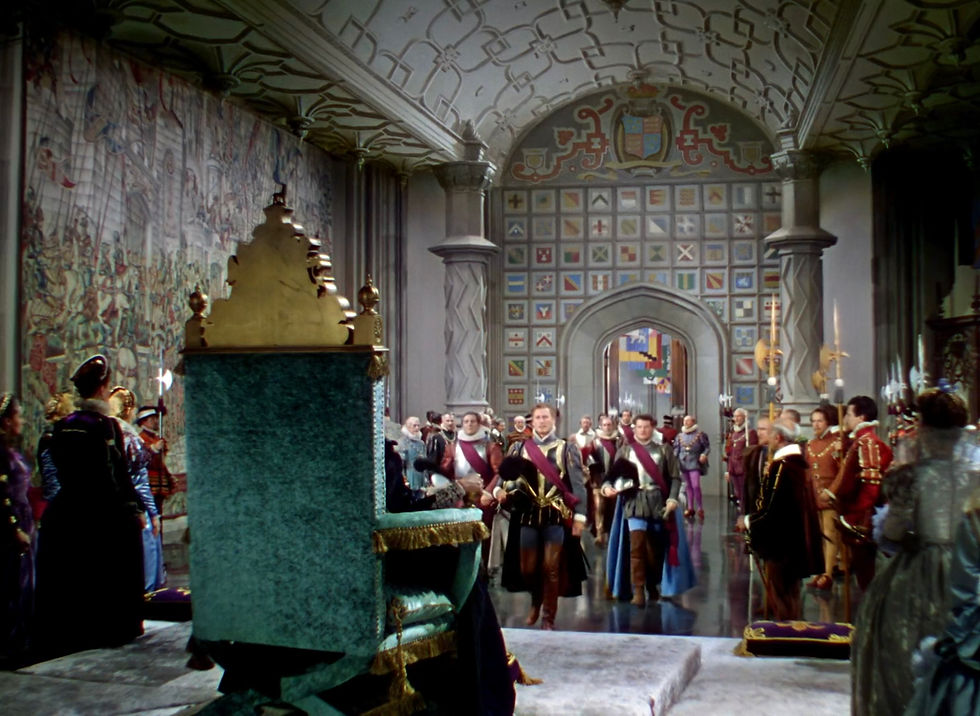

Tyrannical yet brilliant, Hungarian-born Michael Curtiz was Warner Brothers’ top in-house director and among the filmmakers most responsible for shaping the look and feel of classic Hollywood cinema. Bette Davis, who worked with Curtiz on six films, offered a memorable assessment of him in Charlotte Chandler’s book “The Girl Who Walked Home Alone”: “You had to be very strong with him. And he wasn’t fun. He could humiliate people, but never me. He was a real BASTARD! Cruelest man I have ever known. But he knew how to shoot a film well”. Despite his temperament (or maybe because of it), he directed a remarkable array of classics, including many already on this blog: “Mildred Pierce”, “Captain Blood”, “Casablanca”, “The Adventures of Robin Hood”, and “The Sea Wolf”. Click on the titles to open them and learn more about Michael Curtiz and his extraordinary career.

To bring his vision to life, Curtiz had the support of a superlative technical team, beginning with cinematographer Sol Polito, whose exquisite framing and lighting give "Elizabeth and Essex" the look and atmosphere of a fairy tale. There's magic in how he photographs the sets, action, and characters during "Essex's" triumphant return, and in the breathtaking images of "Elizabeth" and "Essex" during their kiss-on-the-steps scene. Whether they're standing, sitting, lying down, or shown near or far, every frame is beautifully composed. Equally impressive is Polito's masterful use of shadows. His gorgeous cinematography earned a Best Cinematography Academy Award nomination, shared with Technicolor expert and cinematographer W. Howard Greene. There's more about Polito's life and career in my post on “The Sea Wolf”.

Also elevating the film are Orry-Kelly’s magnificent costumes. Their colors, textures, cuts, shapes, and styles are extraordinary, from “Elizabeth’s” lace neckwear, jeweled sleeves, and shimmering, billowing gowns, to “Essex’s” gold-trimmed breastplates, dashingly tailored doublets with bold accents and ruffled collars, or the sublime dresses and velvety, silky attire worn by the ladies-in-waiting and courtiers. The richness and opulence of the costumes transport us to another time and place.

I don’t think I’ve ever said this about another film but one could spend the entire time simply admiring the costumes and be mesmerized. Orry-Kelly’s mouthwatering work earned him a Best Costume Design Academy Award nomination. He created memorable wardrobes for countless classics, and you can read more about his life and career in my post on “Some Like It Hot”, and a bit more in “Now, Voyager”. Many of the costumes from this film were reused in the 1949 swashbuckler “The Adventures of Don Juan”, also starring Errol Flynn.

Complementing the ornate costumes are the deceptively simple yet grand sets designed by acclaimed art director Anton Grot. From the warmth of "Essex's" intimate residence and the bustling celebration of London's streets, to the stark isolation of a throne room or the chill of an unexpected staircase, Grot launches us back into the turn of the sixteenth century. It earned him a Best Art Direction Academy Award nomination. Some sets and props were reused the following year in the Warners adventure "The Sea Hawk".

Further enriching the world of “Elizabeth and Essex” are the photographic and sound effects by Byron Haskin and Nathan Levinson (respectively), which earned them a shared Best Special Effects Oscar nomination.

The film’s fifth and final Oscar nomination deservedly went to Erich Wolfgang Korngold for his triumphantly sweeping score, which amplifies both the grandeur of the story and the emotional weight of its characters. Read more about the fascinating life and career of the gifted Korngold in my post on “The Adventures of Robin Hood”.


The extraordinary cast of “Elizabeth and Essex” is certainly at the forefront of why this film is so wonderful, and one of the greatest pleasures is to behold Bette Davis as “Queen Elizabeth I”. A powerhouse of conflicting emotions, Davis makes us feel this woman's complex inner life at a visceral level. Few actors if any are better at making the artificial feel real, and she brings extraordinary humanity to the theatrical dialogue. She never lets us forget “Elizabeth's" a queen while allowing her insecurities, longings, annoyances, and hurts to shine through her royal armor. It’s a spectacular performance and, in my view, one of Davis’ best and most hypnotic. That’s saying a lot given the extraordinary work produced by this legendary two-time Oscar winner. Her emotions can flicker from soft to hard or subtle to overwhelming in an instant, as she reacts to the world outside while showing us her inner turmoil. It’s truly a tour de force, and a performance every Davis fan and lover of great acting must see.


Davis' dedication to acting ran so deep that, unlike nearly every other Hollywood starlet of her day, she insisted on looking like the characters she was playing rather than a glamorous movie star. To prepare for "Elizabeth", she studied portraits of Elizabeth I and researched the queen's personality and habits, incorporating details such as her constant fiddling with her hands. Davis was only thirty-one, while Elizabeth was sixty when the story takes place, so to resemble the aging, balding queen, she wore makeup that paled her complexion and removed her eyebrows, and she shaved her hairline halfway back to enlarge her forehead. In the book "Film Makers on Film Making: Volume Two", Davis recalled having to shave her head every day: “That was terrible. From that I understood how men hate to shave. At six in the morning that noise! And I used to get a black shadow, so they would have to reshave me about five o’clock. Of course, the horror was when the film was over and it started growing out. I tell you, my romantic life was over for quite a while. But that was the only way to do it because she really had no hair”.

Davis was equally determined that "Elizabeth's" wardrobe be historically accurate. As she recalled in her autobiography, "The Lonely Life": “It has always been essential that I dress a part authentically, particularly in the case of a historical character. My cry for the genuine. [Curtiz] insisted that the hoops and tuffs be scaled down for fear they would be too much in the camera… Orry made two complete sets of costumes for ‘Elizabeth’. The first, according to director’s order, the second, according to the historian records. I tested in the first wardrobe and played the picture in the second. Trickery is a determined female”. Davis had to be squeezed into a corset to make her waist look even tinier, and her costumes weighed as much as sixty pounds a piece. In addition, there was no air conditioning on the soundstages, so all of this was under the extreme heat of the giant lamps.
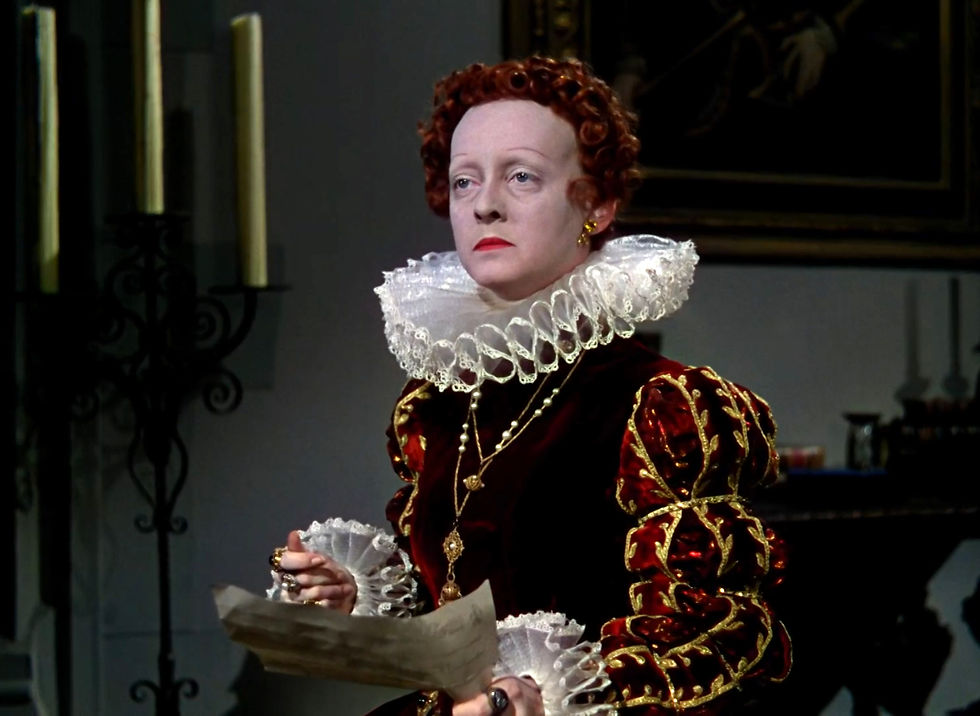

By the time of "Elizabeth and Essex", Davis had become one of Hollywood's finest actresses and a force to be reckoned with, and it hadn't been an easy climb. After starting out in largely mediocre films and frivolous roles, she famously battled Warner Brothers' production chief Jack Warner for better roles and directors. In 1934, she finally broke through with "Of Human Bondage", even doing her own makeup to make her character look ill when called for. Her realistic performance earned the first of eleven Best Actress Oscar nominations. Oscar wins followed for "Dangerous" (1935) and "Jezebel" (1938), and by 1939, Davis was the undisputed queen of Warners, starring in four hit films that year: "Dark Victory", "Juarez", "The Old Maid", and "Elizabeth and Essex". Many expected another Oscar nomination for "Elizabeth and Essex", but she was nominated instead for "Dark Victory". You can read much more about the life and career of the great Bette Davis in my posts on "All About Eve", "Now, Voyager", "Whatever Happened to Baby Jane?", and "Dark Victory”.


Filming "Elizabeth and Essex" was not a happy experience for much of the cast, including Davis, who waged several battles during production. Producer Hal B. Wallis purchased the rights to Anderson's play as a Technicolor prestige vehicle for her, and Davis had her heart set on British actor Laurence Olivier playing “Essex”. But because of the film's enormous budget and the added expense of Technicolor, Warners instead cast its biggest box-office attraction, Errol Flynn. The decision was a bitter disappointment to Davis. She and Flynn had appeared together the previous year in "The Sisters", where they got along despite vastly different approaches to acting. Davis was intensely serious about her craft, while Flynn's famous devil-may-care attitude led him to treat acting almost as amusement. She recalled: “Another dream of mine now came true… I finally was to play ‘Elizabeth’ — and to me the only fly in the ointment was the casting of Errol Flynn as ‘Essex’. He wasn’t an experienced enough actor to cope with the complicated blank verse the play had been written in. There was only one ‘Essex’ I wanted…. In all scenes I dreamed [Olivier] was playing ‘Essex’.”


Flynn's casting created another problem. Because he was such a major star, the film could no longer be titled "Elizabeth the Queen" — it needed to reflect his character as well. Since Flynn was famous for swashbucklers, Jack Warner suggested "The Knight and the Lady". Davis objected, feeling the title diminished "Elizabeth", and threatened to walk off the picture unless it reflected her top billing (though Flynn was earning a higher salary). "Elizabeth and Essex" was considered before the studio ultimately settled on "The Private Lives of Elizabeth and Essex". Flynn, meanwhile, had little desire in making the film. He found Davis overbearing, while she considered him unworthy of the role, creating an icy relationship throughout production. Supporting player Nanette Fabray remembered in the 2005 documentary “Elizabeth and Essex: Battle Royale”: “They would finish a scene, and just when they would say ‘cut’, [Davis and Flynn] would get up and walk in their separate directions”.


To make matters worse, when "Elizabeth" slaps "Essex" in the face in royal court, according to Flynn's autobiography, "My Wicked, Wicked Ways": “She had lifted one of her hands, heavy with those Elizabethan rings, and Joe Louis himself couldn't give a right hook better than Bette hooked me with. My jaw went out. I felt a click behind my ear and I saw all these comets, shooting stars, all in one flash. It didn't knock me to the gourd. She had given me that little dainty hand, laden with about a pound of costume jewelry, right cross the ear. I felt as if I were deaf". Curtiz needed another take, and Flynn recalled: “If your teeth have been rattled, and your head was ringing, and you felt deaf from the pound of costume jewelry hitting you as hard as a lady like Bette Davis can swing — why, I felt a horrible surge of anger that turned my stomach”. He confronted her in the dressing room, and remembers her responding: “I can’t do it any other way! If I have to pull punches, I can’t do this. That’s the kind of actress I am — and I stress actress!”. He responded: “You are a great actress, I know it: so certainly you can learn not to hit me with the whole weight of your fist the next time — and if you can’t do it… well… let’s - leave - it - at - that!”. Ready to hit her back, on the next take, she didn’t touch his face. Davis recalled things differently: “He was perfectly horrid about me in his book — he said that I scratched his face with my rings — of course it’s all ridiculous. I did no such thing. Those are the little things that helped me become [known as] a ‘monster’”.


What makes all of this especially fascinating is that Flynn is terrific in the film. His warmhearted charisma keeps it from becoming a stodgy costume drama, while his relaxed naturalism balances Davis' intensity and the screenplay's theatricality. Had Davis gotten her wish with Olivier, the film might have gained gravitas but lost much of its humor, vitality, and sex appeal. Flynn makes "Essex" completely believable, whether expressing wounded indignation at "Elizabeth's" reprimands, needling "Sir Walter Raleigh" about his silver, or revealing genuine confusion and hurt over lost letters. Most importantly, he shares remarkable chemistry with Davis. They can shift from bitter conflict to profound tenderness in an instant, and every emotional turn feels authentic. When they look into each other's eyes, Flynn seems genuinely overwhelmed with love and affection, while Davis conveys longing and devotion. For two actors who reportedly disliked each other so much, that achievement speaks volumes about their talent. Davis eventually came around to Flynn. At an event I attended honoring Olivia de Havilland in 2006, de Havilland recalled that she and Davis watched "Elizabeth and Essex" decades later, after which Davis turned to her and said: “Damn, he’s good. I was wrong about him all this time".
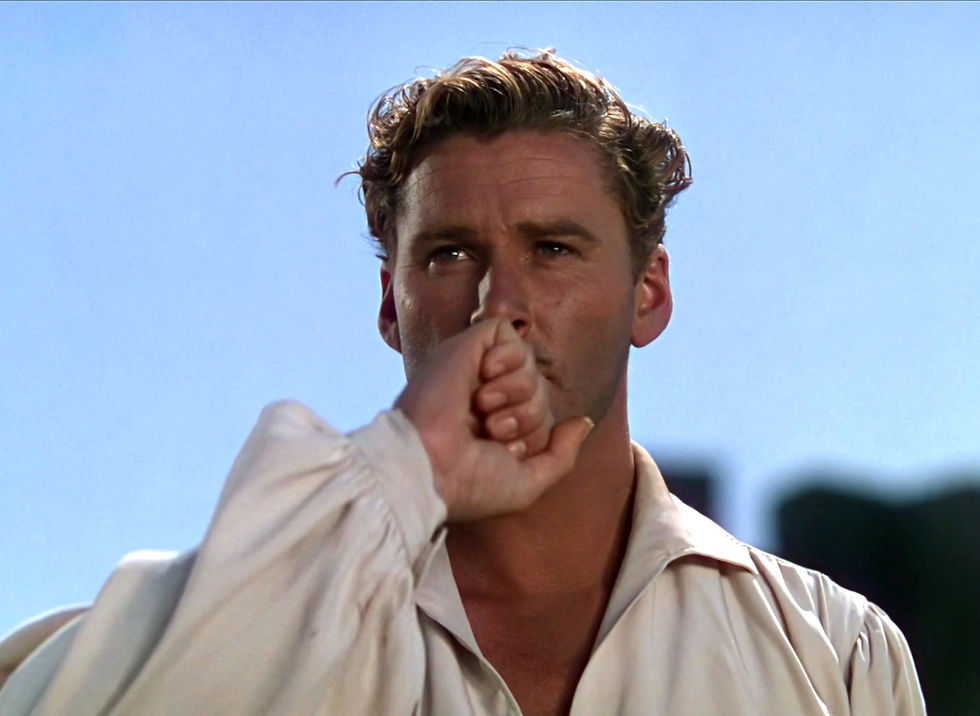

Errol Flynn became a bona fide movie star playing the swashbuckling title role in the 1935 hit “Captain Blood”. He soon proved more dashing and at ease in tights and period costumes than almost any actor before or after, starring in such hits as “The Charge of the Light Brigade”, "The Prince and the Pauper”, and, most famously, “The Adventures of Robin Hood”. By the late 1930s, he was one of Hollywood's biggest box-office draws. Casting Flynn as "Essex" was therefore an obvious choice, though not one he welcomed. Eager to move beyond costume pictures and historical dramas, he was unhappy not only working with Davis but also reuniting with Curtiz for their eighth film together, a director he considered coldhearted and sadistic. Flynn was frequently late to the set and often struggled with his lines, leading to endless retakes. As he said: “It wasn’t a very pleasant picture to make, for me, that is". A man who lived life in the fast lane, Flynn remained a major star into the early 1940s before alcohol, drugs, scandal, and declining health took their toll, contributing to his tragic early death. You can read more about Flynn’s life and career in my posts on “The Adventures of Robin Hood” and “Captain Blood”.


Olivia de Havilland plays "Lady Penelope Gray", one of "Elizabeth's" ladies-in-waiting. Jealous of the Queen and secretly scheming, Penelope is also in love with "Essex". Though not a large role, de Havilland brings remarkable emotional depth to the character, creating a fully realized human being in just a handful of scenes. Her opening scene alone showcases her extraordinary talent, as she watches "Essex's" arrival with desire in her eyes, only to shift instantly to jealousy and resentment when she learns he is seeking "Elizabeth". De Havilland never plays just one emotion, but layers several at once — the schadenfreude beneath her smile during a chess game with the Queen, the mischievous delight as she challenges "Elizabeth" while singing, and the anguish, despair, and hope she reveals while pleading with "Elizabeth" during her emotional climax. There is also "Penelope's" lone scene with "Essex". De Havilland and Flynn shared a magical onscreen chemistry that made them one of Hollywood's most beloved screen teams. This was the sixth of their eight films together and the only one in which she does not play his love interest. Yet despite sharing only one scene (which includes a kiss), their unmistakable chemistry still shines through.


Like Flynn, de Havilland did not want to make "Elizabeth and Essex". After years of playing pretty ingénues in B pictures and lightweight roles, she had become a star, but not a top-tier one — and Warners showed little interest in elevating her career. Frustrated with the parts she was receiving, including repeatedly playing Flynn's love interests, she eagerly pursued the role of "Melanie" in “Gone with the Wind”, also released in 1939. Although under contract to Warner Brothers, she was invited by producer David O. Selznick and director George Cukor to read for the role, despite her contract forbidding it. Selznick wanted her, but Jack Warner refused to loan her out. Determined to win the part, de Havilland secretly invited Jack's wife to tea, explained her situation, and asked for her help. The strategy worked. She was loaned to Selznick, gave an iconic performance as "Melanie", earned her first Academy Award nomination, and finally gained widespread recognition as a serious actress.


Furious that she had gone around him, Jack was determined to remind de Havilland that he — not she — controlled her career. Before she finished filming “Gone with the Wind”, he ordered her back to Warners to appear in the small role of "Penelope". De Havilland refused to film two characters simultaneously, agreeing to shoot only non-dialogue scenes for "Elizabeth and Essex" until her work on “Gone with the Wind” was completed. When Warners attempted to schedule dialogue scenes, she refused, creating tension on the set. To punish her, Jack instructed the crew not to speak to her and, unlike Davis and Flynn, whose names appeared above the title, placed hers beneath it. In the end, however, de Havilland had the last laugh. After leaving Warners in 1943 following her landmark court victory against the studio, she became one of Hollywood's leading actresses of the 1940s and a two-time Academy Award winner. You can read much more about Olivia de Havilland in my posts on “The Heiress”, “Hold Back the Dawn”, “Gone with the Wind”, “The Adventures of Robin Hood”, “Captain Blood”, and in the tribute I wrote on the day she died.


Though many of their roles are brief, the supporting cast of “Elizabeth and Essex” is overflowing with first-rate talent, beginning with the marvelous Donald Crisp as “Francis Bacon”, the intermediary between “Elizabeth” and “Essex”. One of the great strengths of Crisp’s acting was his ability to make his characters believable, and “Francis Bacon” is no exception. Whether urging “Essex” to return to “Elizabeth” or gently reassuring the “Elizabeth” about “Essex”, he serves as a genuine voice of reason. No matter the size of the role, Crisp always brings authenticity, helping convince us that what we are watching is real.

A popular and prolific character actor (and director) whose career stretched back to the Silent Era, Crisp was under contract to Warners when “Elizabeth and Essex” was made (before moving to MGM in 1943), and he appeared in seven films in 1939 alone. You can read more about the wonderful Donald Crisp in my posts on “How Green Was My Valley”, “Red Dust”, “Mutiny on the Bounty”, and “Wuthering Heights”.
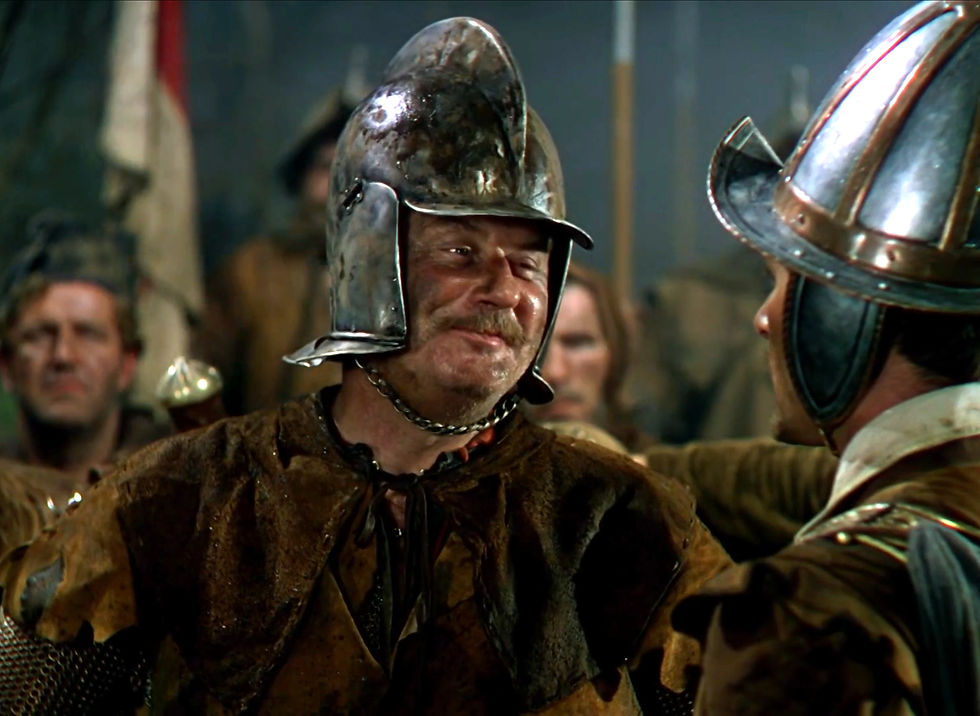

One of the great advantages of the Studio System was the ease with which studios could draw from their stable of contract players to perfectly cast even the smallest parts. Such is the case with Alan Hale as the “Earl of Tyrone”, the Irish military leader whom “Essex” encounters in the marshes. An actor who often brought a jovial quality to his roles, Hale appears in only one short scene, yet with a sly smile, gives the cunning rebel a fully formed personality. It’s convincing actors like Hale who appear for only a line or two that make the worlds inside movies feel alive. We believe “Tyrone” existed before his scene began and that he continues to exist after it ends. That illusion, when successful, is part of the magic of the movies.

A familiar face to classic film fans, Hale appeared in more than 200 films — thirteen with Flynn, of which “Elizabeth and Essex” is a rarity, in that the two actors play adversaries. You can read more about Alan Hale in my previous posts on “It Happened One Night” and “The Adventures of Robin Hood”.

Another recognizable face is Vincent Price, who portrays “Sir Walter Raleigh”, one of the courtiers plotting against “Essex”. Recently signed to Universal and fresh from his film debut, Price was loaned to Warners for what was only his second movie. Like Davis, he studied portraits of the real Raleigh for authenticity, only to discover upon arriving at the studio that his appearance would instead be based on an image of Raleigh found on a can of tobacco.


Price brought previous experience with the material. Having begun his career on the stage, he'd played “Essex” in a summer-stock production of Anderson’s “Elizabeth the Queen”. As a result, whenever Flynn forgot his lines, Curtiz would often have Price feed them to him. As Victoria Price explained in her book "Vincent Price: A Daughter’s Biography": “Vincent realized that the director did this in an effort to shame the star into learning his lines, but [Price] hated being thrust into the middle of their contretemps. The situation finally came to a head when Curtiz warned Flynn that if he wasn’t prepared the next day, he would give the part to Price — a gambit that apparently did the trick”. Price would soon become a popular character actor before achieving immortality as an icon of horror cinema. Read more about his life and career in my previous posts on “The Fly”, “Leave Her to Heaven”, and “Laura”.

Henry Stephenson portrays “Lord Burghley”, the Queen’s trusted adviser and the father of “Sir Robert Cecil”. Another superb actor, Stephenson brings both stately calm and quiet cunning to the role, whether cautioning his son not to provoke “Elizabeth” or showing the slightest smirk as the Queen chastises “Essex” over the lost Spanish treasure fleet.


Born in Grenada, British West Indies to British parents, Henry Stephenson began acting in his mid-twenties, reaching the London stage in 1896 and making his Broadway debut in 1901. While appearing in thirty-five Broadway productions through 1932, he also acted in six silent films shot in New York, beginning with 1917’s “The Spreading Dawn”. His Hollywood debut came when he was sixty-two, playing one of Jean Harlow’s suitors in 1932’s “Red-Headed Woman”, launching a prolific film career. Between 1932 and 1949, Stephenson appeared in eighty-two films, including “Little Women”, “Mutiny on the Bounty”, “Captain Blood”, “Little Lord Fauntleroy”, “The Charge of the Light Brigade”, “The Prince and the Pauper”, “Conquest”, “Marie Antoinette”, “The Adventures of Sherlock Holmes”, “Oliver Twist”, “Enchantment”, and his final, “Challenge of Lassie”. After two 1951 television appearances, he retired. Married twice, including to actress Ann Shoemaker, Henry Stephenson died in 1956 at the age of 85.
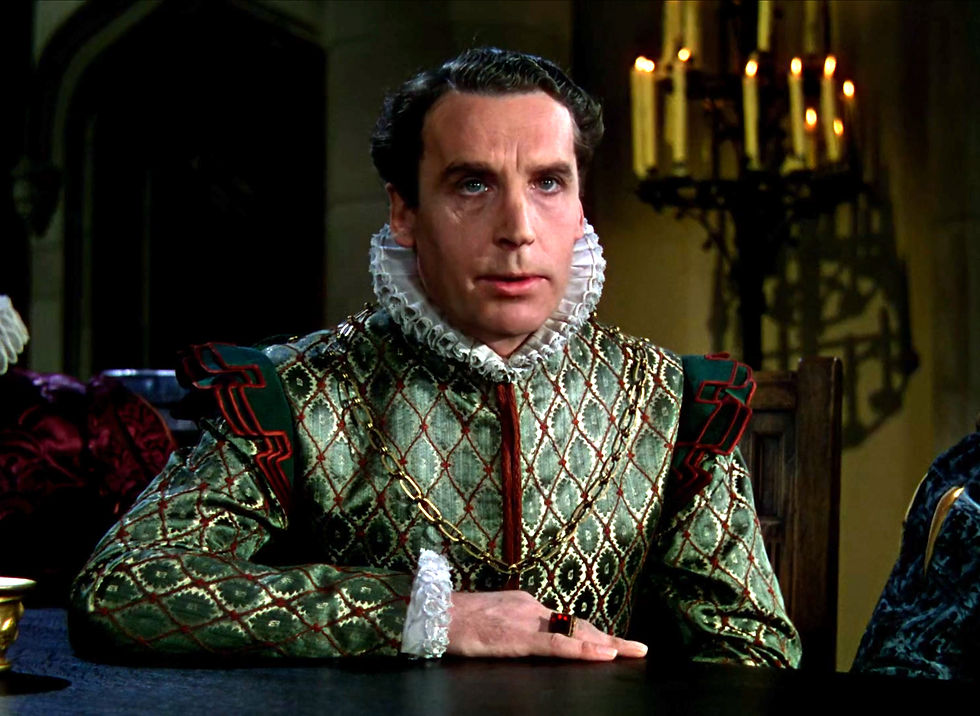
Henry Daniell is equally effective as the scheming “Sir Robert Cecil”, who feels threatened by “Essex” and plots against him. Whether complaining about “Essex” on the balcony, casually “suggesting” that “Essex” be sent to Ireland, or “innocently” asking “Elizabeth” if he may order the guards, Daniell beautifully underplays the character’s resentment and deceit, exquisitely proving “Elizabeth” right when she calls him a snake in the grass.


Born in Barnes, Surrey, Henry Daniell began on the stage before serving in the British Army during World War I, where he was wounded and discharged the following year. He returned to the London theater before arriving on Broadway in 1921 for the first of eighteen Broadway productions over the next forty-one years. His screen debut came in 1929 with “The Awful Truth”, starting a film and television career that spanned thirty-five years and ninety-five roles — many as villains. He appeared in an astonishing number of classics, among them “Camille”, “Holiday”, “Marie Antoinette”, “All This, and Heaven Too”, “The Sea Hawk”, “The Great Dictator”, “The Philadelphia Story”, “Jane Eyre”, “The Body Snatcher”, “Song of Love”, “Lust for Life”, “Witness for the Prosecution”, “Voyage to the Bottom of the Sea”, and his final film, “My Fair Lady”, which he finished filming only hours before his death. Married for thirty-one years, Henry Daniell died of a heart attack in 1963 at the age of 69.


A brief mention goes to Nanette Fabray (credited as Nanette Fabares), who plays “Mistress Margaret Radcliffe”, one of “Elizabeth’s” ladies-in-waiting. This was nineteen-year-old Fabray’s first film, and she arrived nervous and unfamiliar with moviemaking. As she recalled in James Spada’s book "More Than a Woman": “[I] knew nothing about markings or positioning, or what one is supposed to do when the camera is on… Bette was wearing these enormously heavy costumes. The heat must have been unbearable for her. And yet in her very first scene with me, when I kept missing my marks and didn’t know where to look, she very patiently sat in her chair after the others had left for a break and gave me some very quick acting lessons. I didn’t realize until later how unusual it was for someone in her position, under such terrible conditions, to take the time to stay on a set and work with me”. Fabray would go on to enjoy an illustrious, award-winning career on Broadway, television, and film, particularly in musicals. You can read more about her life and career in my post on “The Band Wagon”.


A quick nod to Leo G. Carroll who appears as “Sir Edward Coke”, another member of the royal court. His distinguished face will be instantly recognizable to classic film fans. Carroll appears in five films already on this blog: “Strangers on a Train”, “North by Northwest”, “Rebecca”, “The Bad and the Beautiful”, and “Wuthering Heights”, where you can read more about his life and career.

This week’s superbly crafted film truly has it all — magnificent performances, sumptuous visuals, majestic music, intoxicating passion, and dazzling drama. Enjoy “The Private Lives of Elizabeth and Essex”!
This blog is a series exploring classic films from the silent era through the 1970s. Each post recommends a film to watch, aiming to entertain, inform, and deepen your appreciation of cinema — its stars, directors, writers, the studio system, and more. Be sure to visit the HOME page to learn more, and check out THE MOVIES page for a full list of films. Please comment, share with others, and subscribe so you never miss a post. Thanks for reading!
YOU CAN STREAM OR BUY THE FILM ON AMAZON
OTHER PLACES YOU CAN BUY THE FILM:
As an Amazon Associate I earn from qualifying purchases, and any and all money will go towards the fees for this blog. Thanks!!


Great movie, I have it in my library and I feel like watching it again after reading your wonderful write up. I cannot imagine any other actress of that era other than Bette Davis in the Elizabeth role, and had no idea she wanted Olivier, but despite the apparent tension making the movie, Flynn was good and Bette admits it years later. The famous slap had to look real, just like he one Ann Blyth gives to Joan Crawford. Thankyou for all the on set trivia and your hard work that goes into these movie blogs.
I was able to view this movie about Queen Elizabeth and Essex today.
Always wanted to see it and very glad to have opportunity to do so.
The acting was wonderful and the costumes so ornate and beautiful.
An intense study in human nature and how power can corrupt us and take away true happiness.