


194. THE THREE FACES OF EVE, 1957
An unforgettable, deeply moving, true-life psychological drama

Based on a true story, “The Three Faces of Eve” is more than just enthralling entertainment — it’s a deeply empathetic psychological drama that offers a window into a life experience far beyond most of our own. Pioneering for its time, it left audiences unsure of what to make of it, but now stands as a fascinating, transporting, and profoundly moving work of the highest order, and one that absolutely belongs on your watchlist. An Oscar-winning film that gripped me as a child, it's just as compelling today.

Based on a staggering true story, “The Three Faces of Eve” follows a seemingly ordinary, gentle, unassuming housewife and mother named “Eve White”. Plagued by headaches, blackouts, disturbing lapses in time, and increasingly strange behavior, she and her husband “Ralph” turn to psychiatrist “Dr. Luther” for help. His treatment helps until two deeply alarming incidents shatter any sense of normalcy: an expensive shipment of clothing arrives at the “White” home apparently ordered by “Eve”, who has no memory of it whatsoever; and even more terrifying — their four-year-old daughter “Bonnie’s” life is frighteningly put in jeopardy by “Eve”, who is left with amnesia about the incident.

Under “Dr. Luther’s” care, an astonishing revelation emerges. Before his eyes, an entirely different woman emerges from within her — the flirtatious, carefree, vivacious, and unmarried “Eve Black”. She knows everything about “Eve White” while “Eve White” has no idea “Eve Black” even exists.

With the help of his colleague, “Dr. Day”, "Dr. Luther” confirms the unthinkable — “Eve” is suffering from multiple personality disorder, a condition in which one identity fractures into two or more distinct selves. “Eve White” and "Eve Black” are separate, fully formed personalities, each fiercely battling for control over the same being.

A third personality eventually emerges, and the film charts this woman’s harrowing experiences, anguish, consequences, diagnosis, and treatment. Add to this already riveting story actual dialogue from the real case (giving us rare and direct insight into her lived experience) and a powerhouse Best Actress Oscar-winning performance, and you get a film that unfolds like a page-turning mystery — irresistible and impossible to turn away from.

A dramatization of one of the first documented cases of multiple personality disorder (now known as dissociative identity disorder), the film opens with an introduction by distinguished journalist and commentator Alistair Cooke, who informs us that this case is “something all psychiatrists have read about, and very few have ever seen”. It’s important to remember that in 1957, not much was known about this disorder and the public at large was pretty clueless about it or how it affected people. This film was one of the first major steps in bringing awareness.

Cooke goes on to explain that “This movie needed no help from the imagination of a fiction writer. The truth itself was fabulous enough and all the episodes you’re going to see happened to this girl whom they call ‘Eve White’, and much of the dialogue is taken from the clinical record of the doctor that we call ‘Dr. Luther’”. I’ll provide a bit of information about the real Eve in the TO READ AFTER VIEWING section below, for after you’ve watched the film.

“The Three Faces of Eve” came about when one of Hollywood’s legendary screenwriters and occasional directors, Nunnally Johnson, discovered a soon-to-be-published book by psychiatrists Corbett H. Thigpen and Hervey M. Cleckley, chronicling their extraordinary case of a woman with multiple personality disorder. Under contract to 20th Century Fox at the time, Johnson immediately urged the studio to secure the film rights, which they did.

Johnson met with both doctors, watched their filmed footage of the real Eve, and even spoke with her over the phone, immersing himself in the material. Choosing from roughly a hundred incidents in the book, he selected those best suited for a screenplay and used actual dialogue from the case history to build dramatically charged scenes. In doing so, he transformed these astonishing true events into a high-stakes story tailor-made for the screen.

Though he remained faithful to the essence of the case, Johnson did make certain changes for dramatic effect and to get past Hollywood censors, such as relocating one of “Eve’s” transformations while with a sailor, from a motel bed to the interior of a bar. His screenplay was completed before the book’s publication and the title of his screenplay, “The Three Faces of Eve”, became the title of the book as well. Helped by the film’s success, the book went on to become a bestseller.

Johnson produced, directed, and wrote “The Three Faces of Eve”, though he always considered himself first and foremost a writer. He found comparatively little joy in directing, believing that a film’s true creativity resided in the script. As a result, his direction is intentionally restrained, relying largely on medium shots that allow the drama to unfold within the frame, using subtle camera movements to follow the actors or gently move in and out to reveal telling details rather than have overtly cinematic techniques tell or underline the story.

His deceptively simple approach works beautifully, keeping “Eve’s” plight front and center throughout. Most brilliantly, Johnson withholds our first direct view of “Eve’s” personality changes, allowing us instead to infer it through “Bonnie” and “Ralph’s” terrified reactions. By staging the moment this way, he shifts our attention away from the mechanics of the transformation and onto its chilling consequences. It is an inspired choice, heightening the dread and emotional stakes. Johnson’s unforced, easygoing direction ultimately serves the film superbly, intensifying its haunting emotional power from beginning to end.


Nunnally Johnson considered himself primarily a writer with good reason — he was one of Hollywood’s most respected and prolific screenwriters. Born in Georgia, he began in journalism, first in Georgia and later in New York City for the Tribune and the Brooklyn Daily Eagle. He soon expanded into fiction as well, contributing short stories to The Smart Set and The Saturday Evening Post magazines. The purchase of film rights to his short story “Rough House Rosie” (adapted into a 1927 short film starring Clara Bow) helped prompt his move to Hollywood in 1932. In 1933, he began writing screenplays for Paramount and United Artists before joining Darryl Zanuck at Twentieth Century Pictures. When Zanuck formed 20th Century Fox in 1935, Johnson followed him under contract as a screenwriter, occasionally serving as a producer. During this extraordinarily productive period, Johnson wrote or adapted such films as "The Prisoner of Shark Island”, “Jesse James”, “The Pied Piper”, "Roxie Hart”, and, most notably, 1940’s “The Grapes of Wrath” and 1943’s “Holy Matrimony”, both of which earned him Best Screenplay Academy Award nominations.

In 1943, Johnson left Fox to help form International Pictures, which merged with Universal Pictures in 1946. During that period, he wrote “Casanova Brown”, “The Woman in the Window”, and “The Senator Was Indiscreet” before returning to Fox in 1949. Between 1933 and 1967, Johnson penned more than sixty films and a handful of TV productions. Among the many other films he wrote are “How to Marry a Millionaire”, “My Cousin Rachel”, “The Dark Mirror”, “Phone Call from a Stranger”, “Mr. Hobbs Takes a Vacation”, and his final, “The Dirty Dozen”. He also served as producer or associate producer on forty-two films.

Johnson directed eight films, all between 1954 and 1960, each written or co-written by him, including “The Man in the Gray Flannel Suit", “Black Widow”, “The Angel Wore Red”, and of course, “The Three Faces of Eve”, widely regarded as his finest directorial achievement. He was married three times, and one of his children was editor and writer Marjorie Fowler, who edited "The Three Faces of Eve”. Nunnally Johnson died in 1977 at the age of 79.

"The Three Faces of Eve” was made as a lower-budgeted A film, and at the time, 20th Century Fox insisted that all A releases be photographed in widescreen CinemaScope as a way to combat television, which was rapidly poaching movie audiences. Within those constraints, Johnson pulled off the near-impossible feat of making a psychological drama in widescreen dynamic and visually exciting, which he achieved with the invaluable help of his gifted cinematographer, Stanley Cortez.

A master of black-and-white photography, Cortez fills the frames with rich shadowy areas of darkness, often creating striking patterns across doors, walls, and backgrounds — not always tied to specific visible sources, but often used to texture and energize the space itself. The result is a moody, psychologically charged atmosphere that keeps every frame visually alive and endlessly compelling.


New York City-born Stanley Cortez began his career as a portrait photographer’s assistant. His life changed in 1926 when his older brother, actor Ricardo Cortez, invited him to the set of D. W. Griffith’s “Sorrows of Satan” at Paramount’s New York film studio. In that moment, he decided he would become a cinematographer. He soon made his way to Hollywood and steadily climbed the ranks from assistant cameraman to camera operator, learning from some of the best cinematographers in the industry, like Karl Struss, Lee Garmes, and Hal Mohr. In 1936, Cortez signed with Universal Pictures and made his debut as a solo cinematographer on “Four Days' Wonder”. Though much of his career was spent photographing B movies, his artistry helped create some of the most stunning images in cinema history, most notably in “The Night of the Hunter”, “The Magnificent Ambersons”, and “Since You Went Away”, the latter two garnering him Best Cinematography Academy Award nominations. His extraordinary gift for expressionistic lighting and deep-focus camerawork elevated many films into visually unforgettable classics. The more than eighty films he shot also include “Shock Corridor”, “The Black Cat”, “The Underworld Story”, “The Bridge at Remagen”, and his final, 1980’s “Let There Be Light”. Stanley Cortez died in 1997 at the age of 89.

As producer, Johnson had the freedom to choose exactly whom he wanted in front of and behind the camera, and one of his most crucial searches was for the actress to play “Eve”. In many ways, it was the role no one wanted. According to various accounts, stars such as Lana Turner, Olivia de Havilland, Marilyn Monroe, Doris Day, Carroll Baker, and June Allyson were approached and turned it down either because they were tied up with other commitments or afraid of taking on such an unusual and demanding role.

The actress Johnson most wanted was Judy Garland. At first, Garland reportedly wasn’t even sure what to make of the screenplay — whether it was meant to be a comedy or about a woman merely pretending (again, one must remember that, at the time, the public had no understanding of multiple personalities). But once Johnson showed Garland the filmed footage of the real Eve, everything changed and she became convinced she had to play the part. In the end, however, Garland got cold feet and ghosted Johnson.

By this point, Johnson realized he wouldn’t be able to cast a movie star, and began looking at newcomers. Someone told him to watch an actress named Joanne Woodward in a TV episode of "Four Star Playhouse" opposite Dick Powell. He watched it, thought she was wonderful and sent her the script. Eager to do it, she flew from New York to Los Angeles to meet with him. He hired her and she turned out to be the ideal choice.

Woodward delivers a spectacular performance as three personalities trapped within one woman, bringing each one vividly, distinctly, and believably to life. The film’s success rests heavily on the strength of her stirringly truthful work, and it is the chief reason the story lands with such a powerful punch. From “Eve’s” very first meeting with “Dr. Luther” to her unrelenting moments of helpless bewilderment that follow, Woodward makes us feel every ounce of “Eve White’s” fear and frustration. Whether reemerging in the doctor’s office after the first appearance of “Eve Black” or disorientingly finding herself with a soldier in a bar, Woodward’s unforced honesty pulls deeply at the heartstrings.

And she’s every bit as convincing as party-girl “Eve Black”, capturing her carefree attitude with remarkable truthfulness, whether letting her hair down with “Dr. Luther”, attempting to seduce a hospital orderly, or playing psychological games with “Ralph” in a motel. What makes the performance so mesmerizing is the complete transformation from personality to personality. “Eve Black” has her own posture, rhythm of speech, and physical presence — so fully realized that she feels like an entirely different person from “Eve White”, yet just as real. And when we see Woodward transition from one personality to another, her many nuanced emotions are completely convincing.

As for the third personality — visibly and emotionally distinct from the other two — I’ll leave that for you to discover in the film itself. Woodward’s fantastic performance won her a Best Actress Academy Award, a Golden Globe statue, and a BAFTA nomination, instantly establishing her as one of Hollywood’s most respected actresses. It remains her signature role.
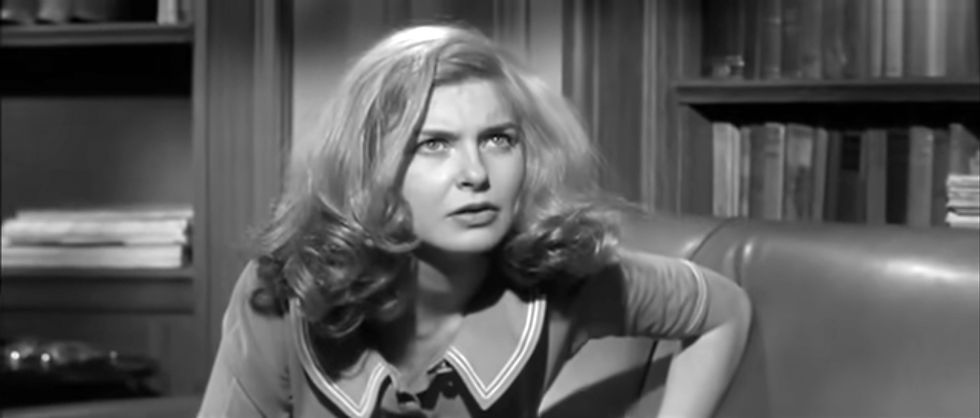

Wanting to become an actress the moment she received applause for reciting the Pledge of Allegiance at the age of two or three, Georgia-born Joanne Woodward began acting in local theater productions and in plays at Louisiana State University before leaving to study in New York City at the Actors Studio and the Neighborhood Playhouse School of the Theatre. It wasn’t long before she was appearing on stage and making her TV debut in a 1952 episode of “Tales of Tomorrow”. In 1953, she landed her first Broadway job as an understudy in the original production of “Picnic”. The show marked the Broadway debut of Paul Newman, and the two became friends during the production. After nearly a dozen and a half TV appearances, Woodward secured her first film role, the lead in 1955’s “Count Three and Pray”, which led to a long-term contract with 20th Century Fox.

Remarkably, Woodward made sure her contract included the unusual stipulation that she could continue living in New York City rather than relocate to Hollywood — an early sign of the fiercely independent spirit with which she approached her life and career. More TV work followed, along with a Broadway starring role in “The Lovers” and a second feature film, 1956’s “A Kiss Before Dying”, before “The Three Faces of Eve” followed by a starring role in “No Down Payment” that same year.


By this point, Paul Newman had also been building his film career while his first marriage was falling apart. Reunited with Woodward in Los Angeles, the two were cast together in her next film, “The Long, Hot Summer”, where friendship gave way to love, and both realized they had found their soulmate. After Newman’s first wife divorced him, he and Woodward married in early 1958, shortly after filming “The Long, Hot Summer" wrapped. Their marriage would become one of Hollywood’s most celebrated and enduring unions. They were paired again onscreen in Woodward’s next film, 1958’s “Rally ’Round the Flag, Boys!”, and from there their careers continued both together and apart (Newman became a star in 1958 with “Cat on a Hot Tin Roof”, quickly headed for superstardom).

Never one to play the Hollywood glamour game, Woodward built her reputation less as a conventional movie star than as an actor’s actor, excelling in leading character roles and becoming especially renowned for her layered portrayals of emotionally complex and psychologically troubled women. In a gesture that perfectly reflected her independent nature, she accepted her Academy Award for “The Three Faces of Eve” in a dress she made herself — a decision that drew some criticism, most famously from Joan Crawford, who quipped “Joanne Woodward is setting the cause of Hollywood glamour back 20 years by making her own clothes”.


While being a devoted wife to Newman and mother to his three children from his first marriage and the three daughters they had together, Woodward continued working steadily in film, TV, and theater, amassing around eighty screen credits. She received three additional Best Actress Academy Award nominations for “Rachel, Rachel” (produced and directed by Newman), “Summer Wishes, Winter Dreams”, and “Mr. & Mrs. Bridge” (opposite Newman). She and Newman appeared together in ten films, including “From the Terrace”, "Paris Blues”, “The Drowning Pool”, and “Harry & Son”, plus the 2005 miniseries “Empire Falls”. Newman directed her in “Rachel, Rachel”, “The Effect of Gamma Rays on Man-in-the-Moon Marigolds”, “The Glass Menagerie”, and the 1980 TV movie “The Shadow Box”.

Among Woodward’s many other films are “The Fugitive Kind”, “Philadelphia”, “The Stripper”, “They Might Be Giants”, and “A Big Hand for the Little Lady”. She received one of her nine Emmy nominations (winning three) for playing a doctor treating a woman with multiple personalities in the 1976 miniseries “Sybil”. In addition to her Oscar and Emmy wins and nominations, she earned ten Golden Globe nominations with three wins, and four BAFTA nominations with one win. She remained active in theater throughout her life, including serving as artistic director of the Westport Country Playhouse from 2001 to 2005.


Woodward’s fifty-year marriage to Newman (ending with his death in 2008) remains one of Hollywood’s most admired love stories. It’s been the subject of the six-part documentary “The Last Movie Stars”, countless articles, and several books, including “Head Over Heels: Joanne Woodward and Paul Newman: A Love Affair in Words and Pictures” by their daughter Melissa, “Paul and Joanne: A Biography of Paul Newman and Joanne Woodward”, and “The Extraordinary Life of an Ordinary Man: A Memoir” by Newman himself. Together the Newmans founded the “Hole in the Wall Gang Camp”, a nonprofit summer camp for children with chronic illnesses. In 1992, they were jointly awarded the prestigious Kennedy Center Honor, and at the tribute Sally Field beautifully observed: “Paul and Joanne take their work and the condition of the world very seriously — but not themselves. Behind those beautiful faces there are beautiful spirits, and profound talent”. In 2007, Woodward was sadly diagnosed with Alzheimer’s disease and gradually withdrew from public life, last appearing publicly in 2013. As of this writing, Joanne Woodward is 96 years old and the oldest living winner of a Best Actress Academy Award.

The supporting cast of “The Three Faces of Eve” is also outstanding, helping shape a credible world that makes us feel we’re watching real events. And that includes David Wayne as “Eve’s” husband, “Ralph White”. A simple, unsophisticated man, Wayne does an excellent job fluctuating between confusion, anger, frustration, and understanding. He has several great scenes, particularly his befuddlement when “Dr. Luther” tries to explain “Eve’s” condition to him, and his careful, unsure responses when “Eve Black” pretends to seduce him in the motel.


Michigan-born David Wayne began acting in a Shakespearean repertory theatre in Cleveland before making his way to Broadway in 1938, and in bit parts in films in 1940. His breakthrough came on stage in 1947 when he originated the role of “Og” in the Broadway musical “Finian’s Rainbow”, earning both a Theatre World Award and the very first Tony Award for Supporting or Featured Actor in a Musical. That show also led to a role in the 1948 film “Portrait of Jennie”. One of the original members of the Actors Studio, Wayne worked across Broadway, TV, and film, appearing in nearly two dozen Broadway productions. He won a second Tony Award for the 1953 play “The Teahouse of the August Moon” and received a third nomination for the 1968 musical “The Happy Time”. He appeared in more than 130 films and TV shows (primarily in supporting roles) including the films “Adam’s Rib”, “Stella”, starring in the 1951 remake of “M”, “The Tender Trap”, “The Andromeda Strain”, and “The Front Page”. He also holds the distinction of appearing in four films with Marilyn Monroe — more than any other actor (“How to Marry a Millionaire”, “As Young as You Feel”, “We’re Not Married”, and “O. Henry’s Full House”).

Wayne spent much of his career on TV, starring in series such as “House Calls”, “Ellery Queen”, “The Good Life”, and “Norby”. He also memorably played the villainous “Mad Hatter” in the 1960s “Batman” television series, and appeared on programs that include “The Twilight Zone”, “Alfred Hitchcock Presents”, “Night Gallery”, “Gunsmoke”, “Dallas", “The Golden Girls”, and an Emmy nominated appearance in “Suspicion”. He retired in 1987, and was married once for over fifty years until his wife’s death. David Wayne died in 1995 at the age of 81.

The role of “Dr. Curtis Luther” in “The Three Faces of Eve” was first offered to Orson Welles, who agreed to do it until he received the green light to direct “Touch of Evil”. As it turned out, that was a blessing, because the part ultimately went to Lee J. Cobb, who is truly outstanding as “Eve’s” principal psychologist.


Since a doctor shouldn't express broad displays of emotion, it’s a deceptively difficult task to keep such a character compelling, and Cobb rises magnificently to the challenge, bringing “Dr. Luther’s” inner life to the surface while keeping him thoroughly professional and deeply human. Watch the intention with which he listens to “Eve” in their first scene together asking about her spells. We can see his mind working while his questions roll off his tongue as natural responses. Cobb is so convincing as a kindly, authoritative, highly competent physician that it doesn’t feel like he’s acting. As stoic as “Dr. Luther” might be, Cobb brings subtleties to this man, like his flicker of confusion as he first encounters “Eve Black”, or the carefully contained excitement when he asks “Dr. Day” whether he can recognize someone with multiple personalities. It’s a role like this, built on nuances rather than overt drama, that reveals what a truly great actor can do, and Cobb deftly demonstrates it.

The film arrived at a high point in Cobb’s screen career, coming on the heels of his star-making, Oscar-nominated performance in “On the Waterfront”, just after his Golden Globe–nominated turn in “12 Angry Men” earlier in 1957, and just before his Oscar-nominated performance in 1958’s “The Brothers Karamazov”. You can read more about Lee J. Cobb’s life and career in my posts on “On the Waterfront” and “12 Angry Men” — just click on the film titles to open them.

The stately Alistair Cooke introduces and narrates “The Three Faces of Eve”, adding gravitas by way of his respected name. That’s because the England-born Cooke was one of the most esteemed and dignified voices in broadcasting on both sides of the Atlantic.


After beginning as a BBC film critic in 1934 and briefly hosting his own NBC radio program in the United States, Alistair Cooke moved permanently to America in 1937, and not long after, became a U.S. citizen. During World War II, he traveled the country documenting the lives of ordinary Americans, and in 1946 began what would become his signature achievement, “Letter from America” (originally “American Letter”), a BBC radio broadcast that ran for an astonishing 58 years, making it the longest-running speech radio program in the world. He was also The Guardian’s U.S. correspondent, covering events he witnessed firsthand as significant as the civil rights movement and the assassination of Robert F. Kennedy. On television, he brought the same intelligence and authority to CBS’s “Omnibus” in the 1950s, and to PBS’s “Masterpiece Theatre", which he hosted and narrated from 1971 to 1993. Cooke’s judgment and presence became so universally respected that anything associated with him instantly carried an air of quality and distinction — precisely why he was ideal to introduce “The Three Faces of Eve”.

As Nunnally Johnson explained to Tom Stempel in a 1969 interview: “I needed somebody to try to give a kind of Good Housekeeping Seal of Approval on [‘The Three Faces of Eve’] to try to persuade people that I was telling almost a documentary story. I got Alistair Cooke to introduce it. At that time he was big on 'Omnibus', and he's so good at that thing. He was careful enough to read the book and satisfy himself that he wasn't lending his name to some joke”. Cooke was married twice. He ended “Letter from America” shortly before his death in 2004, dying less than a month after his final broadcast at the age of 95.

A quick mention of Vince Edwards, who makes a brief but memorable appearance as the Army sergeant dancing with “Eve”, trying to get her to leave the bar with him. Not long after “The Three Faces of Eve”, Edwards became a household name as the title character in the classic medical drama TV series “Ben Casey", which ran from 1961 to 1966 and earned him an Emmy nomination.


Handsome, 6’2", and athletic, Brooklyn-born Vince Edwards originally trained for the Olympic swim team before an appendectomy derailed those plans. So he turned to his other great love — acting. He went on to appear in nearly ninety films and television shows, starting with the title role as a bodybuilder-wrestler in the 1951 low-budget film “Mister Universe” and ending with the 1995 horror film “The Fear”. In between, he built a remarkably varied career. Beyond “Ben Casey”, he starred in the television series “Matt Lincoln”, lent his voice to “Jake Rockwell” in the animated series “Centurions”, and appeared on shows like “The Lucy Show”, “Knight Rider”, “The Highwayman”, and “Murder, She Wrote”, and reprised his most famous role in the 1988 television film “The Return of Ben Casey”. His film work includes “The Killing”, “Sailor Beware”, “Hiawatha”, “Murder by Contract”, and “The Outsider”. Also a singer, he recorded six albums in the 1960s and performed live in Las Vegas and other major cities. He was married four times. Vince Edwards died in 1996 at the age of 67.

This week’s thought provoking, captivating, and touching treat is a film I’m sure you won’t forget. Enjoy “The Three Faces of Eve”!
This blog is a series exploring classic films from the silent era through the 1970s. Each post recommends a film to watch, aiming to entertain, inform, and deepen your appreciation of cinema — its stars, directors, writers, the studio system, and more. Be sure to visit the HOME page to learn more, and check out THE MOVIES page for a full list of films. Please comment, share with others, and subscribe so you never miss a post. Thanks for reading!
YOU CAN STREAM OR BUY THE FILM ON AMAZON
OTHER PLACES YOU CAN BUY THE FILM:
As an Amazon Associate I earn from qualifying purchases, and any and all money will go towards the fees for this blog. Thanks!!
TO READ AFTER VIEWING (contains spoilers):

1957 audiences were unsure what to make of “The Three Faces of Eve” — if it was humorous or not, and criticized the quick transitions from personality to personality as unrealistically quick. But Woodward replicated the actual speed and nature of “Eve’s” transformations from real clinical footage.

The film was based on the life of Chris Costner Sizemore, the woman whose case became one of the most famous documented instances of dissociative identity disorder. Her psychiatrists, Corbett H. Thigpen and Hervey M. Cleckley (“Dr. Luther and Dr. Day” in the film) believed her multiple personalities first emerged at the age of two after she witnessed three profoundly traumatic events: a decomposed corpse; her mother’s arm being slashed by broken glass in a kitchen accident; and a man being dismembered at the sawmill where her father worked.

While the film ends on a hopeful note, Sizemore’s real-life journey was far more complicated. Her personalities were not fully integrated until 1974. After changing doctors in 1970, her new physician discovered she had not three, but twenty-two distinct personalities. Sometime after those identities were unified into a single core personality, Sizemore went on to become a mental health advocate.

When Sizemore signed her life rights to 20th Century Fox, the studio drew up three separate contracts and had each of her three personalities sign one. According to accounts, the handwriting on all three signatures was different. Decades later, Sizemore attempted to challenge the contract, eventually settling out of court.

For those interested, Sizemore later wrote several books about her life and condition: “Strangers in My Body: The Final Face of Eve”,
and “A Mind of My Own”.


So well played movie! Joanne performance is smooth and realistic! Well deserve Oscar! what original i find the introduction of Alistair Cooke at the beginning of the film. I think it was definitely something new and shocking for the times! I like Lee J. Cob and how open and understanding role he played! It is fascinating the actual real story it was based on! Thank you Jay for give us so much information! Great post!
Hi Jay, Watched this movie a few days ago. Wow, really good. Great post about it, like usual! Thanks for posting it as I was not familiar with it.
Best Regards,
Stuart
I'll definitely watch it this weekend, thanks!
Jay, you honor the greatness of people long forgotten. Thank you.
Saw movie as a teen in 1957.
Truly unforgettable and amazing performance by Joanne Woodward.