


197. THE 39 STEPS, 1935
A non-stop thrill ride by the Master of Suspense

While studying film directing in college, twice a week I’d head to Philadelphia’s Roxy Theatre for classic movie double features — four different films every week. Some I’d seen on television, others were completely new to me. But seeing them on the big screen was often like discovering them for the first time. And every now and then, a movie would leave me walking out of the theater thinking, "How could anything possibly top that?"! “The 39 Steps” was one of those films.

The haunting imagery, playful humor, and unforgettable suspense of this fast-paced thrill ride had me completely captivated from beginning to end, and it instantly became one of my favorites by the Master of Suspense, Alfred Hitchcock. Widely regarded as Hitchcock’s first masterpiece, it's lost none of its power over the decades, continuing to earn its place among the greatest films ever made — being named the 4th Best English Film of the 20th Century by the British Film Institute, and most recently, the 8th Greatest Thriller of all time by TimeOut in 2026. This perfectly made film also stands as a stellar example of the fine art of filmmaking.
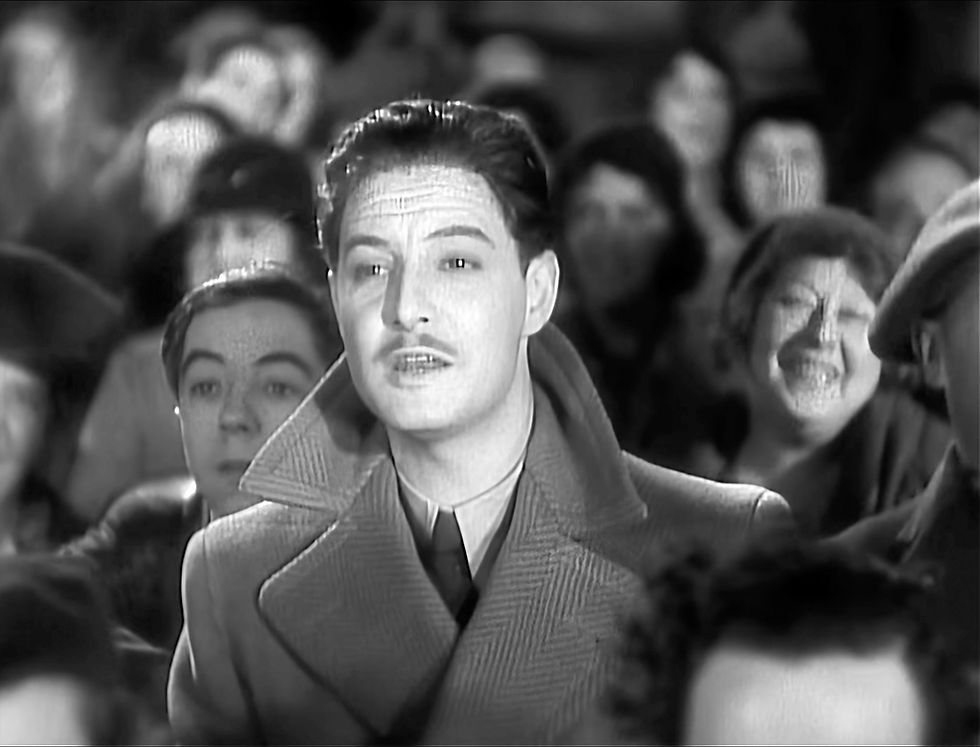
The film begins innocently enough as a man enters a music hall to see a vaudeville show. The man is “Richard Hannay”, a Canadian visiting England for a few months, and he catches the performance of “Mr. Memory”, a man with an encyclopedic mind who answers questions from the audience, including “Hannay’s” “How far is Winnipeg from Montreal?”. As others shout out questions (most repeatedly, “How old is Mae West?”), a riot erupts, a shot is fired, and the audience scatters in panic.

In the scramble to escape, “Hannay" is approached by a beautiful woman who asks, “Can I come home with you?”. He jokingly replies, “It’s your funeral”, and the two return to his apartment. This mysterious woman calls herself “Annabella Smith”, and tension builds as we get the sense she’s in grave danger.

The suspense escalates as she tells “Hannay” she’s being pursued by two dangerous men because she's the only one who can stop some secret agents from smuggling vital British air defense secrets out of the country. She cryptically mentions “The 39 steps”, says she must travel to Scotland to meet a man there, warns "Hannay" about a dangerous man missing part of his little finger, and insists the police won't believe her. If she fails, she says it's only a matter of days or even hours before the secrets leave the country.

Though “Hannay” is skeptical, a shocking twist of events soon throws him into the middle of the conspiracy. Wrongly accused of murder, handcuffed to another woman who thinks he's a killer, and pursued by both the police and ruthless spies, “Hannay” must uncover the truth before either side catches him. What follows is a hair-raising chase across the United Kingdom as he races to find the secret agents and prove his innocence.

One of the most skilled movie directors in history, Hitchcock believed audiences enjoyed fear and wallowed in terror. He understood (perhaps better than anyone) exactly how to manipulate an audience’s emotions, directing them precisely where he wanted them to go. That’s why “The 39 Steps” is such a heart-poundingly fun joy ride. The entire film is crafted to give the viewer a visceral sense of the fear and dread of being unjustly accused, having to lie, hide, impersonate, and do whatever it takes to survive.

Hitchcock sets up the tension immediately, opening the film with slightly askew shots of “Hannay” buying a ticket and entering the music hall without showing his face. The off-kilter angles create an immediate sense of unease, and hiding his identity draws us into the story, making us wonder who is this man and why are we following him. It's a remarkably simple opening that immediately engages our emotions and curiosity.

That same expert artistry continues until the end, creating an undying tension that danger lurks everywhere — even in the most innocuous of things like a newspaper, an open landscape, or the ring of a telephone. We never quite know who or what to trust, as people and places are not always who or what they seem.

The excitement comes from Hitchcock’s desire for heightened emotion over realism. There’s the startling way he shows a knife-in-the-back murder, how amusingly a crowd accepts “Hannay” as a famous political speaker, and the sexy use of handcuffs – all of which we completely accept because of the film’s own logic and the grand emotional payoff they provide. It’s part of what makes Hitchcock such an outstanding filmmaker.

Another example comes when “Hannay” recalls what “Annabella” said about the spies. Instead of a conventional flashback showing her relaying the information, Hitchcock shows her larger-than-life face looming over a darkened street with the spies below, as she slowly reiterates her warning in a controlled voice. It’s a wonderfully imaginative and far more mysteriously suspenseful way to repeat the information than a literal flashback could ever provide. It’s also a perfect reminder that great filmmaking isn’t about reproducing reality, but using cinema’s limitless possibilities to create a vivid, exciting experience.

Also true to Hitchcock’s style is the film’s abundance of humor. There’s the jovial crowd overwhelming “Mr. Memory” with questions, the laughable conversation between two salesmen about women’s lingerie, and, best of all, the inspired shenanigans involving the handcuffs. Even as danger mounts and apprehension tightens, Hitchcock never lets the film become solemn, constantly shifting between humor and tension to keep it buoyant and immensely entertaining. He proves, as he so often did, that suspense and laughter are glorious companions.

English-born Alfred Hitchcock is best known today for his Hollywood classics like “Vertigo”, “Psycho”, or “The Birds”. But long before his illustrious Hollywood career began, he’d already directed more than twenty British features and was widely regarded as one of the world's finest filmmakers. It was while directing British films that Hitchcock honed his craft, including two 1926 productions filmed in Germany ("The Pleasure Garden" and "The Mountain Eagle"), that he observed German Expressionist silent filmmakers — an influence that tremendously helped shape his visual style for the rest of his career.

With "The 39 Steps”, Hitchcock realized his true passion was in crafting suspenseful tales of intrigue and danger. In his youth, he loved the action-packed novels of John Buchan, who reinvented the spy thriller, centering stories around ordinary people who found themselves grappling with extraordinary circumstances. Wanting to direct another spy thriller after making 1934's “The Man Who Knew Too Much”, Hitchcock turned to Buchan’s 1915 novel “The Thirty-Nine Steps” for inspiration. He and writer Charles Bennett used the novel as a springboard, creating a story with added humor, richer characters, new locations, and entirely new action, mapping out every detail of the story before bringing in Ian Hay to help write the dialogue. Buchan attended the film's London premiere and reportedly remarked that the film was better than his own novel.


Widely considered the masterpiece of his British period, “The 39 Steps” is Hitchcockian suspense at its purest, introducing many of the elements that would become his trademarks: the innocent man wrongly accused; the fugitive on the run; mistaken identity; the beautiful blonde; the suave villain; trains; and action unfolding at famous landmarks (here it’s Scotland's Forth Bridge and the London Palladium). The film also features one of Hitchcock's favorite storytelling devices which he called the MacGuffin — something that propels the story and is of enormous importance to the characters, but of little interest the movie audience. Here, it's the British air defense plans. Fans may notice that many of the ideas and themes Hitchcock explored in “The 39 Steps” resurface in his 1959 masterpiece, "North by Northwest”, in which a man flees across the United States rather than the UK to prove his innocence and expose the bad guys.

The brilliance of “The 39 Steps” was key in having producer David O. Selznick lure Hitchcock to Hollywood, and Hitchcock soon moved there to take advantage of the studios and their thousands of technicians and craftspeople, and scale up his films in intensity and grandeur. You can read much more about the life and career of the great Alfred Hitchcock in my previous posts on “Notorious”, “Strangers on a Train”, “Rebecca”, “The Birds”, “North by Northwest”, “Vertigo”, “Psycho”, and “Rear Window”. Just click on the film titles to open them.
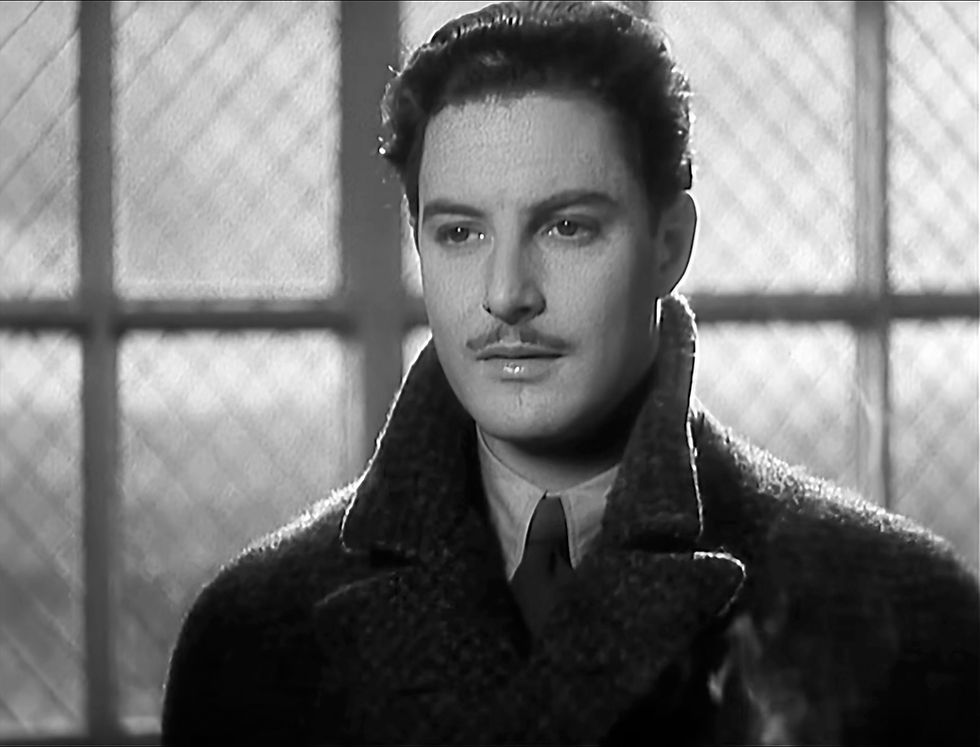
Starring in “The 39 Steps” is Robert Donat as “Richard Hannay”, an ordinary man visiting England who inadvertently becomes caught in a web of crime. Donat is superb at creating a thoroughly believable guy who is constantly forced to think on his feet, weigh decisions, and act quickly. If I reflect on his performance, what rings the loudest are images of him thinking. Watch the subtle shifts he expresses as “Hannay” tries to decide whether “Annabella” is telling the truth, or his remarkable range of emotions when unexpectedly called upon to address a packed political meeting.


Rather than portraying “Hannay” as heroic, Donat plays him as a true gentleman with intelligence, warmth, and quiet resolve. His rich, mellifluous voice and beautifully understated performance never suggest weakness, but make “Hannay” more human and deeply empathetic. Whether gently persuading a milkman to help him or patiently battling “Pamela's” repeated insistence that he's a murderer, Donat reveals a man whose decency is his greatest strength. Hitchcock cast Donat in part because audiences found him immensely appealing, and it's easy to see why. His nuanced, richly resonant performance is one of the film's many highlights.


Born in Manchester, England, as a child, Robert Donat struggled with both a stammer and severe asthma. At eleven he began taking elocution lessons to overcome his speech impediment, and by sixteen was appearing onstage in Shakespeare’s "Julius Caesar". After joining a Shakespearean company, he performed at the Liverpool Playhouse and other notable theaters before moving to London where his acclaimed stage work caught the attention of MGM producer Irving Thalberg. Although Thalberg offered him a Hollywood contract, Donat declined, instead making his film debut in producer-director Alexander Korda's 1932 British film "Men of Tomorrow". Donat signed with Korda and while continuing to work onstage, followed with several films, including his breakthrough performance in 1933's "The Private Life of Henry VIII". Loaned to Hollywood in exchange for Leslie Howard, Donat starred in 1934's "The Count of Monte Cristo", a major international success that prompted a stream of Hollywood offers (including the title role in "Captain Blood”), all of which he declined, preferring to live and work in Britain.


Donat soon became one of Britain's leading stars, regarded as one of the finest actors of his generation. Hoping his international popularity would boost overseas box office, Hitchcock cast him in “The 39 Steps”, which became another worldwide success. Despite his fame, Donat had a massive lack of confidence and remained highly selective about the roles he accepted (and poor health caused him to lose others). He turned down numerous films, including Hitchcock's "Secret Agent", "Sabotage", and “Rebecca". His selectiveness did little to diminish his reputation — he received a Best Actor Academy Award nomination for 1938's "The Citadel", then won the Oscar the following year in the title role of "Goodbye, Mr. Chips" (beating Clark Gable for "Gone with the Wind"). He appeared in only nineteen feature films and one TV production, and his other notable works include "The Winslow Boy", "The Magic Box", "Vacation from Marriage", "The Adventures of Tartu", and "Lease of Life" (which earned him a Best British Actor BAFTA nomination). He died shortly after completing "The Inn of the Sixth Happiness" opposite Ingrid Bergman, for which he received a posthumous Golden Globe nomination. Donat also directed and starred in the 1949 film "The Cure for Love".

Plagued throughout his life by worsening asthma, Donat's health increasingly limited both his stage and film work during the 1950s. While performing in theater, he reportedly kept an oxygen bottle just offstage. Married twice, including to actress Renée Asherson, Robert Donat died in 1958 at the age of 53 from a blood clot on the brain, shortly after being diagnosed with a brain tumor.

Starring opposite Donat is Madeleine Carroll as “Pamela”, a beautiful, sophisticated woman who also becomes entangled in the espionage. Strong-willed and spirited, “Pamela” has no trouble standing up to the man she believes is a murderer, whether in their first encounter aboard the train, her impertinence at the political meeting, or her exasperation while handcuffed. Yet Carroll never presents her as one dimensional.

She reveals “Pamela’s” humanity in the smallest moments, from her frustration trudging across the moors, to the wonderfully genuine reactions that play across her face (from annoyance, to sarcasm, to reluctant amusement) as “Hannay” rambles on about murder and Madame Tussaud's on the hotel bed. Equally impressive is the subtle way she lets “Pamela’s" distrust slowly melt into affection, beginning with the softened expression she gives when “Hannay” hangs her stockings by the fire. Carroll’s impeccable comic timing makes “Pamela" funny, touching, and wholly engaging.

Of the film's many delights, perhaps none is more satisfying than the sparkling chemistry between Carroll and Donat. Her cool, hard reserve against his quiet warmth is irresistible, making us long for the moment she finally realizes he's innocent. Their banter can be playful, as when they cross the moors, mischievous, as in the hotel room, or quietly sexy when she has to remove her wet stockings while handcuffed together. To help create that chemistry, Hitchcock had the actors meet for the first time at a rehearsal, handcuffed them together and walked off with the key, leaving them chained together for hours. Their shared frustration eventually turned to laughter, developing the sizzling rapport that shines so brightly in this film.


English-born (of French and Irish descent) Madeleine Carroll originally planned to become a French teacher at her father's insistence. But during her final year at the University of Birmingham, she appeared in a school play and was bitten by the acting bug. When her father forced her to leave home after she decided to pursue acting, she briefly taught French at a girls’ school, worked as a hat model and private tutor, while searching for acting jobs. After winning a beauty contest, her stage career began in 1927, touring and honing her craft onstage. Her film debut followed as the female lead in 1928's "Guns of Loos", and within little more than a year, her beauty and cool intensity made her Britain's biggest female movie star. With “The 39 Steps” came international fame. Hitchcock cast her because of the confidence and poise she naturally projected, as he explained in William Hare's book Hitchcock and the Methods of Suspense: "How very well Madeleine fitted into the part. I had heard a lot about her as a tall, cold, blonde beauty. After meeting her, I made up my mind to present her to the public as her natural self”.


In “The 39 Steps”, Carroll became the prototype for Hitchcock's famous "icy blonde” — intelligent, poised, and independent, with a tantalizing "look but don't touch" sexuality. Hitchcock famously described this type of woman as "a lady in the drawing room and a whore in the bedroom”, and variations of this seemingly unattainable woman with smoldering passion beneath her cool exterior would appear in films throughout the rest of his career. Hitchcock reunited with Carroll the following year in “Secret Agent”, though “The 39 Steps” remains her signature role. Carroll's success in “The 39 Steps” made her the first British actress to sign a major Hollywood contract. Known as both "The Queen of British Cinema" and "The Most Beautiful Woman in Movies", in 1938 she became the highest-paid actress in the world. By 1942, she had appeared in nearly forty films, including "The Prisoner of Zenda", "My Favorite Blonde", "The General Died at Dawn", "Lloyd's of London", "The Case Against Mrs. Ames", "I Was a Spy", "Honeymoon in Bali", "On the Avenue", and "The First Born".


The death of her younger sister, Marguerite, in a WWII German air raid on London in 1940 forever changed Carroll. Feeling she could no longer portray glamorous heroines while innocent women died, she largely left acting to devote herself to the war effort. Fluent in French, Spanish, and Italian, she served with the American Red Cross in Europe, worked in field hospitals, entertained troops, broadcast anti-Nazi radio messages throughout Europe, donated money and property to the cause, helped war orphans, and later assisted in the rehabilitation of concentration camp survivors. In 1949, she proposed to the U.S. Committee of UNICEF that an International Children's Day be established. Her wartime humanitarian work earned her both the French Legion of Honor and the American Medal of Freedom. Finding it difficult to revive her career once returning to Hollywood, she appeared in just three more films, a Broadway show, and a handful of radio and TV programs before retiring from acting by 1960, settling first in Paris and later in Spain. She was married and divorced four times, including to actor Sterling Hayden and French producer-director Henri Lavorel. Madeleine Carroll died in 1987 at the age of 81.

The supporting cast of “The 39 Steps” is equally superb, including the haunting performance of Lucie Mannheim as “Annabella Smith”, the mysterious woman who sets the story in motion. Mannheim creates intrigue from the moment she appears, wanting to accompany “Hannay” home. Once inside his apartment, she becomes utterly bewitching — insisting the lights remain off, mirrors be turned around, window shades drawn, and urgently warning "Don't answer the telephone... because I think it's for me”. Her tangible fear and anxiety make us fully invest in “Hannay’s" predicament, while establishing the atmosphere of suspense that will permeate the rest of the film. It’s a powerful performance.


Born in Berlin, Germany, Lucie Mannheim began her career on the stage performing Shakespeare, Ibsen, and other works while becoming a celebrated figure in the Weimar Republic's cabaret scene during the 1920s and early 1930s. She was so popular that operettas were written specifically for her, including Walter Goetze's 1931“Die göttliche Jette” . She began appearing in German silent films in 1919, later making a seamless transition to sound, and was the leading contender for the title role in Josef von Sternberg's 1930 classic “The Blue Angel” until Sternberg discovered a then-unknown actress named Marlene Dietrich who he cast instead. Being Jewish, Mannheim's career in Germany came to an abrupt end with the Nazi rise to power in 1933. Dismissed from her position at the State Theater, she fled to the United Kingdom to escape persecution, where she continued working on stage and screen — most memorably in “The 39 Steps”. During World War II, she appeared on BBC radio broadcasts aimed at German soldiers, often performing her well-known anti-Hitler parody of the song "Lili Marleen".


After the war, Mannheim returned to Germany, where she resumed her acting career and, in 1963, was awarded Germany’s prestigious honorary title of “Staatsschauspieler” (State Actor). Over the course of her career, she appeared in fifty-seven film and TV productions, including "Bunny Lake Is Missing", "Hotel Reserve", "The High Command", "Yellow Canary", "The Expulsion", "Der Schatz", and the 1955 television series "The Scarlet Pimpernel". She was married at least once, to English actor Marius Goring. Lucie Mannheim died in 1976 at the age of 77.

Among my favorite parts of “The 39 Steps” is the sequence in which “Hannay” spends the night at a farmer's house. Much of its emotional power comes from Peggy Ashcroft as “Margaret”, the farmer's wife. Through the quiet honesty of her performance, Ashcroft reveals an entire life in just a few scenes. We feel “Margaret’s" yearning as her face brightens while talking about Glasgow or hearing of the London ladies with painted toenails, then sense how trapped she is the moment her husband enters the kitchen. Even the smallest expressions — as when she realizes “Hannay” is accused of murder, or after he gently kisses her — carry remarkable emotional weight. It's a brief but truly unforgettable performance.


Developing an early a love of Shakespeare, London-born Peggy Ashcroft was determined to become an actress. At sixteen she enrolled at the Central School of Speech and Drama, while immersing herself in Konstantin Stanislavski's revolutionary approach to acting. After graduation she developed her craft onstage, joining the famed Old Vic company in 1932. She made her screen debut the following year in "The Wandering Jew", followed by “The 39 Steps”. Though she appeared in just fourteen feature films through 1988, she devoted more than sixty years to the theater, becoming one of the greatest stage and Shakespearean actresses of the twentieth century. In 1961 she became a founding member of the Royal Shakespeare Company alongside Laurence Olivier and John Gielgud. Most of her film roles came later in life, most memorably her Academy Award, BAFTA, and a Golden Globe winning performance in “A Passage to India” at the age of seventy-seven (the oldest actress to date to win a Best Supporting Actress Oscar).


Ashcroft's other films include "The Nun's Story", "Sunday Bloody Sunday", "Secret Ceremony", "Madame Sousatzka", her final, "She's Been Away", and the voice of “Hilda Bloggs” in the animated feature "When the Wind Blows". Her TV work includes "The Jewel in the Crown", "A Perfect Spy", "The Wars of the Roses", "Six Centuries of Verse", and "Edward & Mrs. Simpson". In addition to her Oscar, Ashcroft earned eight BAFTA nominations (with three wins), two Emmy nominations, two Golden Globe nominations (one win), and a British Film Institute Fellowship. She was appointed Commander of the Order of the British Empire (CBE) in 1951 and Dame Commander of the Order of the British Empire (DBE) in 1956. Married and divorced three times, Peggy Ashcroft died in 1991 at age 83.

Another spellbinding performance in “The 39 Steps” comes from John Laurie as “John”, the farmer. A masterfully understated portrayal, Laurie reveals this jealous, provincial, deeply religious man through the smallest reactions. Notice his “I can’t be bothered” attitude and curt replies when he first meets “Hannay”, the possessive way he quickly corrects “Hannay” that "Margaret" is "my wife" not his daughter, and most poignantly, the mixture of confusion, hurt, and quiet despair that cross his face as he looks at both “Margaret” and “Hannay” while saying grace before dinner. Like Ashcroft, Laurie communicates volumes in remarkably little screen time.


Born in Scotland, John Laurie abandoned a career in architecture to serve in WWI. After the war, he decided to become an actor, enrolling at the Central School of Speech and Drama before making his stage debut in 1921. Over the next two decades he established himself as one of Britain's finest Shakespearean actors, performing at both the Old Vic and Stratford-upon-Avon in productions such as "Hamlet", "Macbeth", and "Richard III". His film debut was in Hitchcock's 1930 "Juno and the Paycock", followed by Michael Powell's "Red Ensign" in 1934, before “The 39 Steps”, starting a prolific screen career. Although Laurie worked steadily in film and television for decades, widespread fame didn't arrive until he was in his seventies, when cast as pessimistic undertaker “Private James Frazer” in the hit BBC sitcom "Dad's Army" (1968–1977).


Over the course of his career Laurie appeared in more than 160 films and TV productions, including "The Edge of the World", "The Four Feathers", "The Life and Death of Colonel Blimp", "I Know Where I'm Going!", "The Way Ahead", "Caesar and Cleopatra", "Hobson's Choice", "Kidnapped", "The Abominable Dr. Phibes", and his final film, 1979's "The Prisoner of Zenda". He first worked with Laurence Olivier in the 1936 film "As You Like It", and was the only actor (besides Olivier) to appear in all three of Olivier's directed Shakespeare films — "Henry V", "Hamlet", and "Richard III". Married twice and widowed once, John Laurie died in 1980 at the age of 83.

"The 39 Steps" was remade for the British screen in 1959 and 1978, and for BBC television in 2008. A stage adaptation premiered in London in 2006 before opening on Broadway in 2008. I saw the Broadway production, but don't remember it well, other than thinking it wasn't nearly as good as Hitchcock's film.

This week's classic remains pure cinematic excitement from beginning to end, proving that suspense never goes out of style. It's also a masterclass in great filmmaking. Enjoy “The 39 Steps”!
This blog is a series exploring classic films from the silent era through the 1970s. Each post recommends a film to watch, aiming to entertain, inform, and deepen your appreciation of cinema — its stars, directors, writers, the studio system, and more. Be sure to visit the HOME page to learn more, and check out THE MOVIES page for a full list of films. Please comment, share with others, and subscribe so you never miss a post. Thanks for reading!
YOU CAN STREAM OR BUY THE FILM ON AMAZON
OTHER PLACES YOU CAN BUY THE FILM:
As an Amazon Associate I earn from qualifying purchases, and any and all money will go towards the fees for this blog. Thanks!!
TO READ AFTER VIEWING (contains spoilers):

Hitchcock made cameos in many of his films, usually within the first ten minutes so audiences wouldn’t spend the movie looking for him. In “The 39 Steps", he appears just before “Hannay” and “Annabella” board the bus to his apartment, walking past in profile in a hat and overcoat, casually flicking what appears to be a card onto the ground.


Another great movie from Hitchcock! Sitting and watching his movies you already know it’s going to be a wonderful ride! He is so talented! Definitely one of my favorites one!
Its curious how watching the movie reminded me to North by Northwest and after reading the blog you also mentioned! The night scenes in the mountains are beautiful and so artistic!
I loved the opening of the movie, the train, the cabein scenes, the handcuffs as union element, the hotel ladie…. It’s fantastic movie! Peggy Ashcroft Performance, even short one is my favorite one! Is so authentic and complex… as you said Jay, she expresses so much saying very little!
I missed Hitchcock appearance in this one! I thought because…
Hello, Jay! I loved your review. I had forgotten just how fantastic this film is! I definitely have my Hitchcock favorites, and this one is easily in my top five. Thank you for reminding me just how great it is!
Seleus
Silver Screen Classics & Nostalgia
Jay, thanks again for a great review of a classic film! So much great camera work that's so entertaining, for the era it broke new ground. Its been years since I saw this movie, I'm going to give it another viewing. I always wonder if there were gasps in the theater in 1935 when the lingerie was held up to the camera. Risqué stuff for the day!